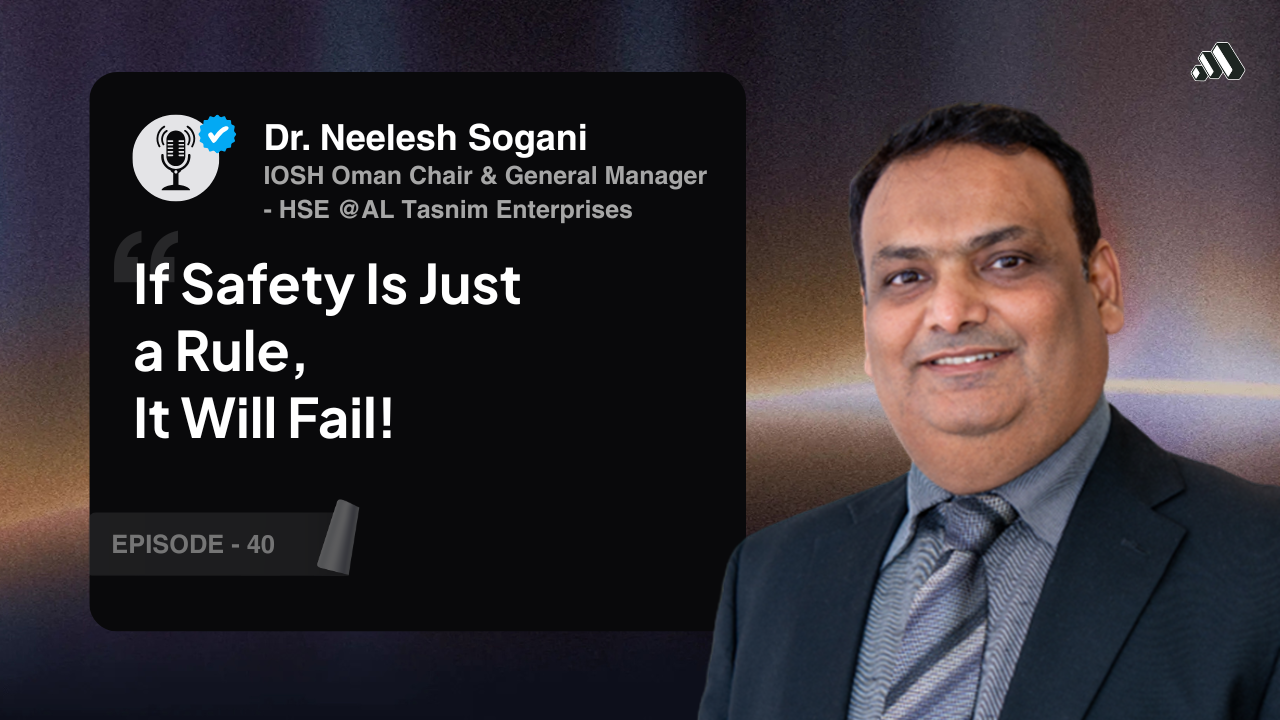
The Truth About HSE: Safety Is Not Just a Department
%20(1).png)





.avif)
Introduction
In this conversation, Dr. Neelesh Sogani, General Manager for HSE Training and Development at Al Tasnim Group, shares insights on the importance of Health, Safety, and Environment (HSE) practices in organizations. He discusses the challenges faced in implementing effective HSE strategies, the need for a mindset shift among leaders, and the integration of HSE with Environmental, Social, and Governance (ESG) goals.
Dr. Sogani emphasizes the role of technology in enhancing HSE practices and the importance of considering psychosocial risks in the workplace. He concludes with a call for organizations to prioritize safety and well-being as a core value, ultimately leading to improved productivity and profitability.
"HSE is a mindset, not just a process."
- Dr. Neelesh Sogani
Key Takeaways
- HSE is essential for ensuring workplace safety and well-being.
- A mindset shift is necessary for effective HSE implementation.
- HSE should be integrated into organizational planning and decision-making.
- Investing in HSE can lead to long-term profitability.
- Challenges in HSE often stem from a gap between procedures and reality.
- Regional differences affect how HSE is perceived and implemented.
- Technology can enhance HSE practices but also introduces new risks.
- Psychosocial risks are increasingly important in HSE assessments.
- HSE and ESG are interconnected and should be integrated.
- Organizational culture plays a crucial role in HSE success.
Transcript
Hello and welcome to Building Momentum. Today, I'm excited to welcome our next guest, Dr. Neelesh. General Manager for HSE Training and Development at Al Tasnim Group. There's always this sort of a tug of war between speed, productivity, and business goals.
As you are touching the real ground, you know the conditions for that. What's actually in the investing? No organization in the world. They don't, you know, budget for any incidents. They are putting a helmet. Something to think about that it is putting a, you know, load on your head. The other thing is that it is going to be protective. If we go through the HSC processes, it delays our productivity. A single incident happened. Texas incident, know, Gulf of Texas, BP incident.
It feels like it's holding them back only until an incident occurs.
My name is Yash, your host for the show and today I'm excited to welcome our next guest, Dr. Neelesh, General Manager for HSE Training and Development at Al Tasnim Group. We'll get to know more about Al Tasnim Group and the journey of building and growing it. So join me in welcoming Dr. Neelesh who's here to share his journey and insights. Dr. Neelesh, thank you for doing this. How are you dong today?
Yeah, good. Thank you. Thank you Yash for inviting me and it's a pleasure for talking with you on this moment.
Absolutely. if you can start with explaining a little bit about what Al Tasnim Group does and then what you do at Al Tasnim that will be a fantastic start.
Sure. So I'm Dr. Neelesh Sogani. I'm working as a general manager at HSE with the AL Tasnim group. So I recently joined the group, but I am working in Oman since last 19 years. So Al Tasnim is one of the biggest, you know, one of the biggest contractor contracting company diversified in different fields. So we are in the oil and gas manufacturing, mining, roads and infrastructure. are not only in Oman, but also we are extended our legs in North Africa and other part of the Middle East.
So as a general manager of health and safety, I'm transforming the HSE, how we manage the day-to-day business in Al Tasnim and getting into the next level. And this is what my core job with Al Tasnim. But being in Oman or being in the industry from last 19 years and almost with the 28 year of experience. So I'm working on transforming HSE, wellbeing and the ESG for building the safer, sustainable workplaces.
Awesome. So for the folks who are uninitiated, could you explain what is HSE, what is ESG, what are ESG goals? So just the fundamentals.
So when we talk about the HSE, HSE is a division which is health, safety and environment and our core responsibility is that whatever we do as a business, we ensure that people who work for us, they work safely, they go back home safely. And this is added with the new philosophy of EAC, which is environment social governance, which is hand to hand with the HSE. But there we also look about the sustainability.
the corporate governance, how the people live, how the people work, they are taken care and also the responsibility in terms of the impact on the society and on the community as well as on the environment part.
Sorry. So no points to the audience for guessing what's going to be the topic of our conversation with Dr. Neelesh today. It's going to be health and safety and wellness of the people who are working. And then we'll also touch some bits on environment and sustainability as well. While you joined Al Tasnim recently, you've been 19 years in Oman. You've worked significantly in HSE as a domain.
in your opinion and experience. What have you seen as a consistent challenge in health and safety across multiple organizations that you've worked with or you interacted with? is that one consistent challenge that you see?
When we talk about the HSE, know, the repetitive challenge, you go across any industry, whether in oil and gas or construction or mining, the challenge what we get is that what we imagine that how the work should be done and how the work is being carried out. And that is purely because of, you know, sometimes the organization doesn't go for the work that talks. So we in reality, we develop a, you know,
very excellent procedures, risk assessments, method statements, a fantastic, you know, HSE management system. But in reality, when the work is being done, the situation is dynamic, condition changes, and people improvise because of the changing in the deadlines, targets, and other situations. And this is how this brings the gap where what is being written, how to do, and what is being done. And that gap brings the causes of
accidents near misses or the chronic heart stress.
Yeah. It's to say that there's always this sort of a tug of war between speed, productivity, business goals. And so people who are in charge of driving those goals and achieving those targets are always sort of at odds with having to follow the HSE process and sort of feel like it's holding them back. But it feels like it's holding them back only until an incident occurs.
Would that be a thing to say?
You know, you're touching the real grounds, you know conditions what happens actually in the industry, but when you ask my opinion specifically, I don't see it as a, you know, or it is a, you know, talk of war because it's in the mindset how the, you know, the organization thinks. So if you really, you know, put it together that, you know, operation or productivity and their safety are, you know,
not complementing each other and normal mindset is the HSE become a blocker for the productivity. Yeah. That's not true because if you integrate the, know, and that's the problem in the system, how you design the thought process, what happens to the, you know, to the leadership level, because if you go into the industry, the pressure is normal. The type deadlines, the complex interfaces and the cost countries, it's always human.
that.
Right. Yeah. So now the key thing is that how you design safety in your day to day work planning and how you execute your planning. Now, that's very important. In general, what happens is organization thinks HSE is a cost center. So they develop the HSE as a requirement for getting the certifications.
as compliance item, like a check mark.
system on the paper, yeah, it both exercise. But when they come to the real world environment, you know, they feel like, you know, if we go through the HSE processes, it delays our productivity. And yeah, that is a, you know, very bad concept among the, you know, boardrooms. So they should think that HSE is a cost center for them and the investing in HSE is, you know, reducing their bottom line. But where I see that if you rightly invest
in HSE and if you integrate HSE into your planning in your decision making in setting your KPIs it means the HSE becomes the strong engine for your reliability continuity and long term profitability. So in a very simple language if you have a good investment in HSE and the operation culture is HSE oriented your downtown will reduce your productivity will increase because
no organization in the world they when they prepare for their budgets, they don't you know budget for any incidents. They don't budget for any downtime and a single incident happen like you know the Texas incident, you know Gulf of Texas the BP incident how much it cost a single incident how much it cost to the company.
Yeah, and to the world actually in that case to the world as well
It's not only to the world, to the environment, to the society. if BP was a bigger organization, they sustain that job. If it was a small scale industries or small organization with that type of job, they completely go from the business. That's what I say, that if your focus is integrating the planning in your decision making.
and in your setting APIs, if you take HSE along with your business, it becomes a good business, good engine for getting long term profitability, reliability and your business continuity.
I hope this insight sort of travels to as many business leaders as possible and I'd be extremely happy to be proven wrong in thinking that HSE is a compliance item for most leaders. If most leaders sort of, like even if we forget about the HSE processes and requirements and stuff like that, even if we just start thinking of it as a mindset, just having that as a mindset,
everything else follows, right? So if that priority is given just because of the mindset, if that's how the thinking happens, then that also can inspire that sort of change, right? And so one of the other things...
Sure, you absolutely touch a very good point. you know, I'll give you a very simple basic example. So when we go and drive the vehicle, right. And if you feel that putting a safety harness is becoming a burden to my body or it is creating stress to my body, right. On the other side, if you see that it is my responsibility on it is my, you know, need to put a bed. like we go to the site and putting a helmet.
Some people think that it is putting a, you know, load on your head. Whereas other thing it is going to protect you. Right. So that shift in the mindset is very important.
Got it. Got it. The other thing that I also, so like I was, I've been researching, went through the profile and things like that also. I see you worked across multiple regions as well. And so across India, Oman, broader Gulf, all of these places that you worked, do you see like a difference in how HSE is looked at or ESG is looked at broader term as well?
how that is looked at across different regions. So is the difference in looking at HSE and ESG industry specific like a function of industry or is it a function of geography? like in your opinion what how it is set up.
See?
See, fundamentally, you look at, know, the HSC remains same, whether you work in India, you work in Middle East, you work in North Africa, you go to any part of the world. Because we all are a human being, right? And it is in our instinct that everybody want to be safe. Everybody want to be respected. Everybody want to get their voice to be heard. And they want to confidence that they go home safe every day when they finish the work.
Yeah, but when you point about you know, the how the HSE looks different when you have a different geographical locations or different industry And that's that's a big challenge, right? Because it all depends that how mature is your regulatory, you know requirement how the informants enforcement is, you know, good so If it is a corrupted enforcement where you know things are acceptable. You just move through or you take take both exercise
Yeah, also it's a industry specific. So if you look into the oil and gas industry, especially like I've seen in India, I've seen in Oman, I've seen in the North Africa. So oil and gas industry or high risk industries, because it is a need of the industry that you need to comply for each and every requirement and then organization get that to the maturity that yeah, it has to be done and they consider that in all your project budgeting or on your operation budgeting.
But if you go into the different non-oil and gas industry or less risky industries like the construction, there, you know, they take the HSE because the governance and the compliance and performance enforcement is not so strict. that it is acceptable. So the level of HSE even in the same country, even in the same geographical locations, it differs from industry to industry, from
sector to sector and also like you know, if you have a big companies or multinational companies, so it becomes like a core of their business in their planning itself. Whereas if you go into the small scale industries or the you know, local community contractors or the subcontractors where they are more because they are bidding for the job on the cost aspects and to become competitive in the market.
They try to shortcuts and especially when the things comes for the shortcutting it comes to the quality and HSE. Yeah, you see the difference of, you know, HSE compliance. Now, when you talk about the India, you know, you have a major workforce as a, you know, Indians, but when you come to the Middle East, right? So you have a diverse workforce. So you have people from the different nationalities. have a different background.
For you know cultural background. So the hse become you know If you look in some places when the person gets into the vehicle As a cultural he ensure that he wears a seat belt right seat belt and in other part There is a policeman I wear the belt Then I go in with my luxuries. So yeah, these all you know based on your
Then I'll read those.
You know cultural background your you know locations your literacy labor your cultural expectations it thinks it changes but Again, it's industry driven things. So high risk industries drive more on the HSE. Whereas the low risk industries They put less emphasis on the know HSE
One of the things that I've also noticed is is that a lot of the times a large organization because they are under scrutiny a lot and there are regular audits and stuff like that, which are third party and sometimes in critical industries even audits by by the government, right? So a lot of the times what we've seen is that these large organizations to get around HSE will have their own HSE processes and everything that they will follow. But there is certain cases to
Optimize for the cost and to optimize for the time they will subcontract it so that they don't have to like it's the subcontractors You know look out as well and which is And so that's why right so that's why like Processes and everything are important with some mindset that that comes first. They give the mindset is is oriented towards this then
You know, you won't look at HSE as a compromise. think that's one of the, like, if this is to the audience, to the people who are listening to this or watching this on whatever platform, like, if there's one thing that you take away from this conversation, is that HSE is a mindset, right? It is not a, like, it could be a set of process, but it's a mindset. the other thing that I wanted to ask you, Dr. Neelesh, given the rapid changes, you know,
evolving regulations, technology stacks, global dynamics. What are the major risks that organizations should anticipate, let's say over the next half a decade or a decade? Where do you see the trend moving to?
So that's a really big, you know, great question, sir. And it's really bringing, you know, lot of change in the thought process for the HCC professionals. So the way the technology is changing and it is, you know, it's bringing, you know, both the positive and the, you know, the negative together with it. Like,
when these with the new technological changes when you have a more AI automations, your robotics, your Internet of Things, right? So this can help significantly for improving your HSE. So if the organization invests, so one thing is that how the traditional way of managing HSE has to move from the traditional approach to the tech based approach. So that's the one thing. So it is in terms of managing the HSE or EAC at the work front.
But it also brings the new cyber physical race. If you know, it is not handled properly. If you have more reliance on the technology or without competence of the people because we need to upscale our people for changing, for using these changes in the technology, also the cyber reliances, right? So if we don't handle it properly, it brings the new path for the failures, right?
Also the other challenge which the industries are getting is especially the climate change the global global warming and associated climate change the psychosocial risk, especially we have seen after the covid right. It is it is, you know, added the psychological safety aspects because people, know getting
more impacted because of the psychosocial risk rather than the just traditional hazards at the workplace. The other aspects like, you know, the community expectations, the stress, the fatigue, the burnout, all these are the, you know, different focuses which are added on the, know, the HSE shoulders so that when they do the risk, you know, assessment at the workplace, it is not just what you see directly hazards.
with your activities or with your work or with your operation, you need to also, you know, include or you need to also integrate the additional risk which is associated with the technology, the psychosocial risk and all these, you know, the burnouts and all other issues. Now, other challenge what we see is because the way the industries are, you know, expanding with the global supply chains and the global ecosystem.
So if you have any single, you know, weak link at any of your, you know, in your process that leads to the larger incidents and your reputational damage. So for example, if you have a, you know, incident at a isolated at your one location, it is just gets escalated to your local community. But when you expand your one incident can cause impact on your global image and that impacts on your bottom line, your reputation.
and also the comfort of the employees that you know whether I am working safely in this organization or I safe in this organization or not. these are the things which really you know from the organizations to now they need to start thinking to invest in the resilient systems, the data driven insights, know the multi-skilled teams. So now it's not that you have a mechanical engineer he just know about the mechanics.
You should also be, you multi-skilled in terms of using the automations, the robotics or IOTs, right? And also the cultural adoptions, right? So when you work with the different cultural things, you know, how quickly you adopt, how quickly you learn. So now the organization should be thinking in advance before any incident comes or before any, you know, enforcement comes as a rule or a
on the legal authorities. you know, now, you know, with these old changes, organizations require forward thinking that they should anticipate what is coming forward. And this is how it's changed the complete dynamics of HSE professionals as I saw, you know, the boardrooms.
Yeah, no, mean, if organizations, I mean, this is if you're waiting for regulations to change, it's already going to be too late. If you want to stay ahead of the curve and that's the sign of a there's a sign of a progressive organization that is that. Yeah, absolutely. That they are setting the industry best practices, which then later on become regulations for for the people who are or the organizations who are.
Make open answers.
who are following them and it's interesting you touched upon this a little bit earlier, but while you like you work towards sustainability and this is something that I wanted to like before I let you go. I wanted to ask you a question around this because I like I don't understand how these two work together. Right? So you mentioned this a little earlier when you said something around climate as well and sustainability as well. And so how are
How are ESG goals like environment sustainability, like how are ESG working with HSE? Like what's the connection and how do you link that with the environmental responsibility, long-term sustainability? If you could explain that a little bit.
That's really great question and you know, most of the organizations now when they are moving with HSE and ESG together. Okay, so many of the organization the EHG is taken care by the financial guys in terms of the reporting in the the financial reporting. But to me, ESG and HSE are not the separate as it does. They work together and these are the different lenses of seeing the responsibilities but
sustainability and EAC. So both are hooked with the safety. So in as a health and safety, we look how we protect the people today. But whereas the sustainability and EAC look that what will be the impact on the people, community and the environment over a long term. So in my context, right, there is a big connections between the EAC and HSE because
how we design the life cycle thinking. So now we don't just look into the, you know, in terms of the risk assessment on the operation. We also look the forward that with this operation, what will be the impact in the future? And this is how the EAC get integrated with the HSE. For example, if we are designing a plant, if you are designing a pipeline, if you're designing a new road, right? So now in the design itself, the EAC and HSE comes together.
that how we reduce the energy use, how we reduce the maintenance needs, how we reduce the waste and in that way that safer design brings the sustainability as well. Right. As part of the ESEE is about the social, right. And when we talk about the social, it talks about the workers welfare, which is very close to the HSE, the community impact, the ethical labor practice, which is again, you know, related to the safety.
So it means the core HSE domain where the E is also about the environment. So in HSE, E is about environment. Yeah. Yeah. E is how we manage the risk assessment for the H and S part. In the same way, we do the risk assessment in terms of the E part, which is, you know, in terms of how we cover the spills, how we reduce the emissions, how we reduce the waste or how we, you know, exclusively use the resources.
So ultimately, if you look up at the robust HSE performance, it is the combination of HSE and ESG together. And this is why now many of the organization, they don't think the EASD and HSE is separate. It is the integrative integration of how we manage safety and moment and the social governance. And that is the reason now HSE professionals are getting involved.
as a risk and responsible leaders helping the organization for integrating safety, well-being and environmental stewardship into the creating a long-term sustainable value for the organizations.
Interesting it want to show a little bit of my ignorance as well because I when I was showing talking about the abbreviation. I would say HSE, but then I only expanded it to health and safety. I I did not include environment like it's towards the end of our of our conversation that I that when you pointed out, I realized that HSE the E stands for stands for environment and that's the connection and that's how
Progressive forward-thinking firms are sort of putting both of them together and just thinking of that as one thing itself. But this has been a brilliant conversation, Dr. Neelesh. Thank you for taking out the time. We've gotten a lot of insights from this conversation. I'm sure if you found value in this conversation or if you have any questions, do drop in the comments as well, wherever it is.
that you are watching this or listening to this whether it is on YouTube or listening to it on Amazon music or Spotify or Apple music as well. Do drop in a comment and happy to answer any questions that you have. Consider liking sharing and subscribing as always. Thank you for tuning in until next time. Bye.
Thank you. So I just want to add one more thing. Sure, sure. So the mindset of the people or mindset of the boardroom has to change, right? So normally we plan for the reality, not for the perfection. So if organization starts pushing, you know, planning the things in the way that they anticipate what all can go wrong. And then they, you know, they integrate that into the planning.
Because normally what happens is when something goes wrong under the pressure, the people start getting the shortcuts, right? But if your planning is very robust, right? It consider what are the failures in terms of the tight schedule, the resource issues, the timeline. If you integrate all together and also if you start developing your frontline workers or frontline supervisors to especially
as a mini CEOs, because these are the people who are dealing with the day to day pressure. If you give them the leadership skills, if you give them the proper insight of the data, so that, know, and if you have a guideline, that these are my shortlist of non-negotiables, which will never get compromised. Even my schedule get impacted, even my budget get impacted. So if that, you know,
line is clearly set in the organization. It means that gives a clear directive that this is the area where no compromise on the safety. And this is how we integrate HSE into the planning, decision making and KPIs. And this will really help the organization to increase their profitability, to increase their productivity and the HSE become hand to hand like your operations and it gets the real letters. And it is, you know,
HSC is about saving the people. It is about the people, right? So if the boardroom puts themselves in the shoes of others and see that what, you know, what it makes, because ultimately organizations can get the replacement. So if somebody die or somebody get injured in the workplace, you easily get the replacement. But think about the family.
They don't get the replacement for a son, as a husband, as a wife, as a doctor. Right? And second thing, if you are ensuring that people are going everyday safe, they are kept every second safe at your workplace, it increases their morale. And in that way, they are more, you know, connected with the organization, not as an employer or employee. They take it as a family.
and then it improves the organizational culture. So for this, I initiated two my own drives. One is go beyond zero. So most of the organization, they look at HSE as a statistics, then how many incidents or how many LTIs happens. Whereas you go beyond the data, see that how positive influence you do at your work force.
And I was also realizing that the workplace other than the workplace safety, the road safety, even when you are at home with your family, road safety is, you know, the biggest concern. I drive, I initiate you, which called as a drive for family. So it means whenever you are behind the steerings and if you think what will happen if I harsh brake, if I accelerate, I speed, I take wrong overtaking.
So whatever I take a action behind the steering, how it is going to impact on my family, family. If that thought process is there, you'll never violate or you will never never take the shortcuts. this applies same at the workplace or at the on the roads. So basically we, you know, this is my message to all the HCC professionals who is seeing this podcast that you are in a noble job because
People go to the doctor when they are sick or injured, right? Yeah. But you as a HSE professional is driving that you don't allow people to go to the doctor because you don't want them to get injured. So it is a noble profession. live with this profession and show that you build a culture where people self-buying because when there is a self-buying by the supervisors or workers at the work front, they will always think HSE from their
from their mind, not because of the compliance reason, because they want to go home safely. And this is what the message I want to give. And the same thing I want to tell to the professionals who are experienced that please develop the future leaders in HSE or in the ESE because they are going to drive in future and they need to adopt technology as a enabler, not.
and see as a blockers. So thank you for having me on this podcast.
No, thank you for the message. This is a brilliant, brilliant way to think about it. Every time, just generally in life, not even while I'm doing something at my firm or anything like that, just generally in life, just having that as a mindset that my choice, how is that? Is that going to?
improve the stability happiness index of my family or is that going to decrease it or is that has a potential to decrease it and and just you know keeping that in mind is a is a great way to even draft policies for others and also just how do I conduct myself right 30 seconds of adrenaline rush that I will feel when I you know push on the accelerator paddle is that really worth it is a is a great way to
we do think about it and so thank you sir for sharing this as an insight and for coming on to our show. We'd love to have you back on and we'll talk about some other topic that time as well but thank you for joining us.
I'll be happy to support you. Thanks. You're doing a great job.
Thank you. Absolutely. Thank you, sir.
The inbox update you’ll never want to skip
A quick catch-up with ideas, wins, and tips worth stealing, straight to your inbox every week.
The easiest way to reach us.
Share your details and we’ll get back within 24 hours.
Podcast

A plethora of insights,all in one place
From strategy to execution. All the big ideas, practical guides & fresh perspectives that’ll help you scale with confidence
Ebooks
Comprehensive guides that break down the shifts in business and technology, Helping you lead with clarity.

Office Hours
Your direct line to our experts. Practical advice for scaling, right when you need it.
Reports
Data-backed perspectives on where industries are headed, giving you the foresight to make bolder moves.
Newsletter
A quick catch-up with ideas, wins, and tips worth stealing, straight to your inbox every week.
.avif)
Podcasts
Conversations where you get to know everything from the ones who know it best.
.avif)
Hire Offshore Developers, Right Now!
Access top-tier global talent, enterprise infrastructure, and complete regulatory compliance through our proven model.
Start Now