So richten Sie ein Offshore-Entwicklungszentrum in Indien ein



%20How%20Riyadh%20Companies%20Set%20Up%20an%20Offshore%20Development%20Center%20in%20India.jpg)
Many companies still assume offshore teams exist only to cut costs, but that thinking is outdated. Today, leaders build value by creating focused engineering units in India. Strong IT export growth, now projected beyond 224 billion dollars, and the rapid rise of GCC centers show why. You’ll see this shift when you study how fast AI, automation, and deep engineering roles grow in major Indian hubs.
If you want to understand how to set up an offshore development centre, the real advantage comes from tapping into specialized talent and clear processes. Modern teams use India for AI, full-stack work, and product extensions.
The process works well, but success depends on solid planning and the right offshore development centre setup process from day one.
Phase 1: Strategy & Models (Before You Build)
Before you plan how to set up an offshore development centre, you need a clear model that supports your long-term work. This choice affects cost control, hiring, performance, and ownership.
Teams that skip this stage often deal with unclear responsibilities later. Picking the right structure keeps your offshore development centre setup process steady and predictable.
Step 1. Dedicated Team Model
A Dedicated Team operates as an extension of your engineering group. You guide the roadmap, quality bar, and delivery flow, while the India team focuses only on your product. This model fits companies building AI features, full-stack modules, or areas that require strong context.
It’s a good fit when you want:
- Direct oversight on engineering decisions
- Long-term stability
- Work that benefits from steady product knowledge
This setup works well when you expect multi-year development and want engineers aligned with your standards. It also supports operational areas like offshore project management, data security offshore, and scaling teams across major hubs in ODC India 2025.
Step 2. Build-Operate-Transfer (BOT) ODC
The BOT model is a structured path for companies entering India for the first time. A partner builds the office, manages hiring, handles compliance, and runs operations until the center becomes stable. After that, the entire unit transfers to you.
Companies choose BOT when they want quick scale without handling entity registration, legal compliance India ODC, or early HR operations. It’s a strong option for teams that want ownership later but need initial support with ODC infrastructure India, vendor management, and local policies.
This is also popular among companies expanding into GCC market India due to predictable timelines and lower early risk.
Step 3. Managed ODC
A Managed ODC focuses on outcomes. The partner handles hiring, delivery, and operations, while you own the product direction. It works for teams that want fast ramp-up or limited operational involvement. You still access strong tech talent India, but without handling administrative tasks.
Quick Comparison
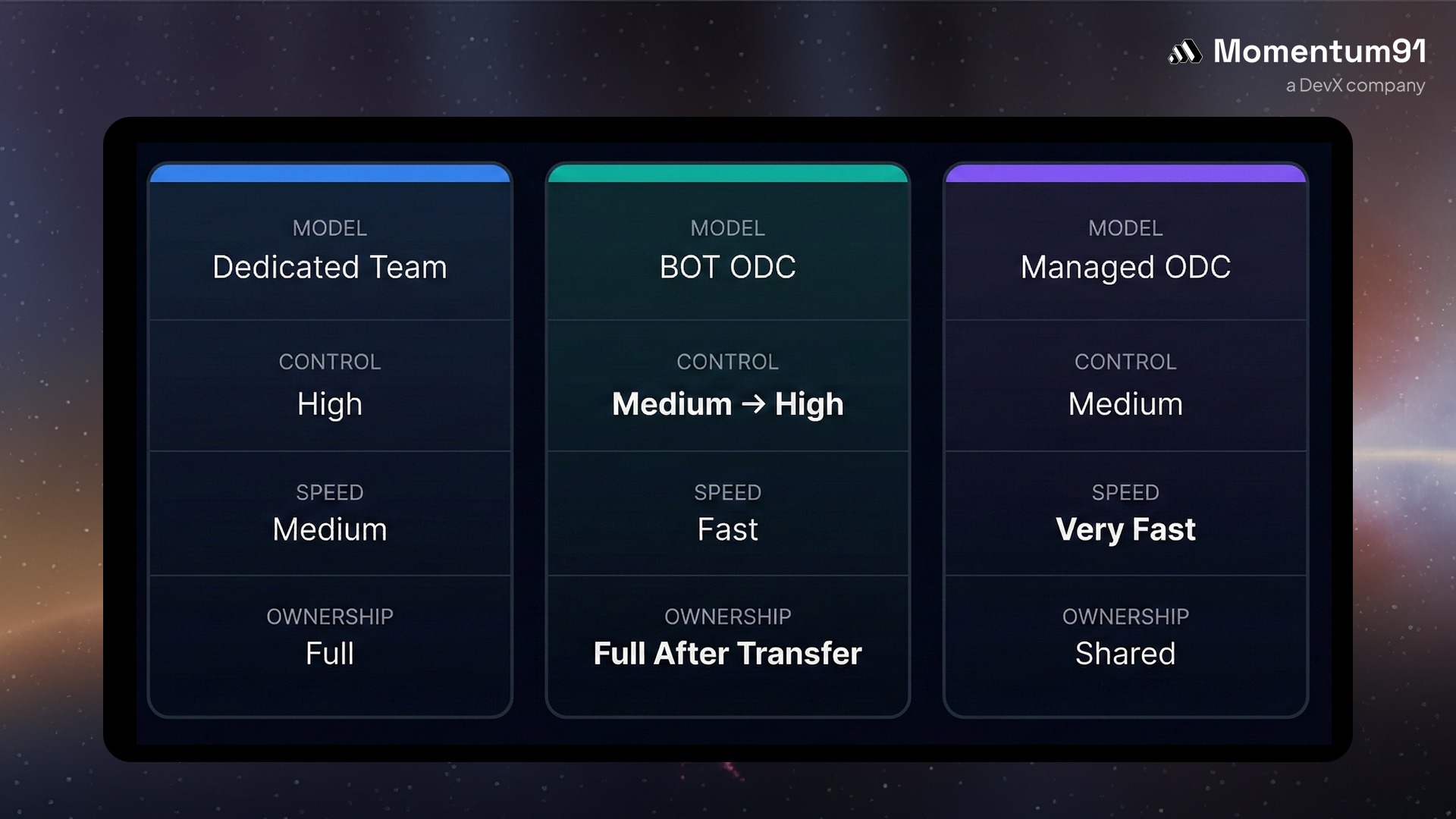
Once you select the right offshore development centre models, the next step is building the foundation with the correct location, compliance structure, and infrastructure.
Phase 2: The Execution (The Setup)
Once you know how to setup an offshore development centre, the next step is putting the structure into action. This stage covers location decisions, compliance, infrastructure, and hiring.
Each part needs a clean process because small gaps early can slow down delivery later. A consistent offshore development centre setup process keeps the rollout smooth and avoids expensive corrections in the first year.
Step 1: Location Strategy (Indian Tech Hubs)
Your location shapes team quality, cost, and leadership availability. Tier 1 Indian tech hubs like Bengaluru, Hyderabad, Pune, Chennai, and NCR give you deeper access to AI talent, senior architects, and product engineers. These cities already support global firms moving into the GCC market India and provide strong hiring pipelines.
Tier 2 hubs such as Coimbatore, Kochi, Ahmedabad, Indore, and Jaipur offer lower operational costs with reliable talent. These regions attract engineers who prefer long-term stability and flexible work options.
Pick your location based on:
- Depth of tech talent India
- Office and infrastructure cost
- Availability of leadership hires
Step 2: Legal & Compliance
Setting up an ODC in India requires a clean compliance path. You’ll choose between a Private Limited Company or an LLP based on ownership plans and taxation. A Private Limited model works best for most companies due to easier investment structures and stronger ESOP options.
Your compliance checklist includes corporate registration, tax setup, labor laws, legal compliance India ODC duties, and policies like POSH. You also need contracts aligned with IP transfer rules, data handling, and cross-border controls.
Step 3: Physical & Digital Infrastructure
Your ODC needs a secure environment that supports engineering work from day one. This includes leased office space or plug-and-play workspaces, dual ISP connections, VPN access, and device security controls. Many teams build their setup around ODC infrastructure India standards such as ISO 27001 or SOC 2.
Core requirements:
- High-speed, redundant internet
- Secure laptops and endpoint tools
- Access controls for code and cloud
- Organized DevSecOps stack
Step 4: Talent Acquisition
India’s tech talent India ecosystem gives you access to full-stack engineers, AI/ML experts, QA teams, DevOps roles, and more. Build a hiring plan with clear interview loops, technical benchmarks, and a strong employer brand.
Key hiring steps:
- Start with a site lead or senior engineering manager
- Build squads around feature ownership
- Use structured interviews to maintain consistency
This approach strengthens offshore project management and supports long-term retention.
Phase 3: Operations & Risk Management
Daily operations decide everything, from delivery consistency to retention and long-term trust. A steady operational rhythm keeps your offshore development centre setup process aligned with quality standards across engineering, security, and team behavior, especially as ODC India 2025 grows in complexity and scale.
Step 1. Data Security & IP Protection
Security isn’t optional for an ODC. You need a mix of legal safeguards, restricted access, and reliable tooling to protect your code and product knowledge. Strong NDAs, IP assignment terms, and contracts built around legal compliance India ODC form the baseline.
On the technical side, teams rely on secure laptops, controlled permissions, MFA, and monitoring tools that flag suspicious access. Companies working in regulated industries often align with ISO or SOC 2 requirements tied to ODC infrastructure India, since these frameworks support safe handling of sensitive data.
When you add structured reviews and clear coding policies, engineers work confidently without exposing risks related to data security offshore.
Step 2. Culture and Collaboration
The strongest ODCs run like an extension of the main office instead of a separate block of people. That depends on shared expectations, transparent communication, and a predictable workflow. When both teams use the same roadmap, documentation patterns, and sprint habits, collaboration feels natural.
Giving engineers in India ownership of features improves accountability and reduces confusion. It also strengthens offshore project management, since teams stop depending on constant instructions and start contributing real product direction. Culture grows when teams see the same standards, the same clarity, and the same trust as the headquarters receives.
Step 3. Retention & Team Stability
Retention shapes long-term success more than any single hire. India has deep tech talent, but top engineers expect growth, clarity, and meaningful work. You build stability by offering well-defined roles, regular feedback cycles, and learning opportunities tied to product evolution. When engineers feel connected to the product’s outcomes, they stay longer and contribute more.
This stability becomes even more important as companies expand into the GCC market India, where consistent delivery and dependable engineering teams directly influence scale.
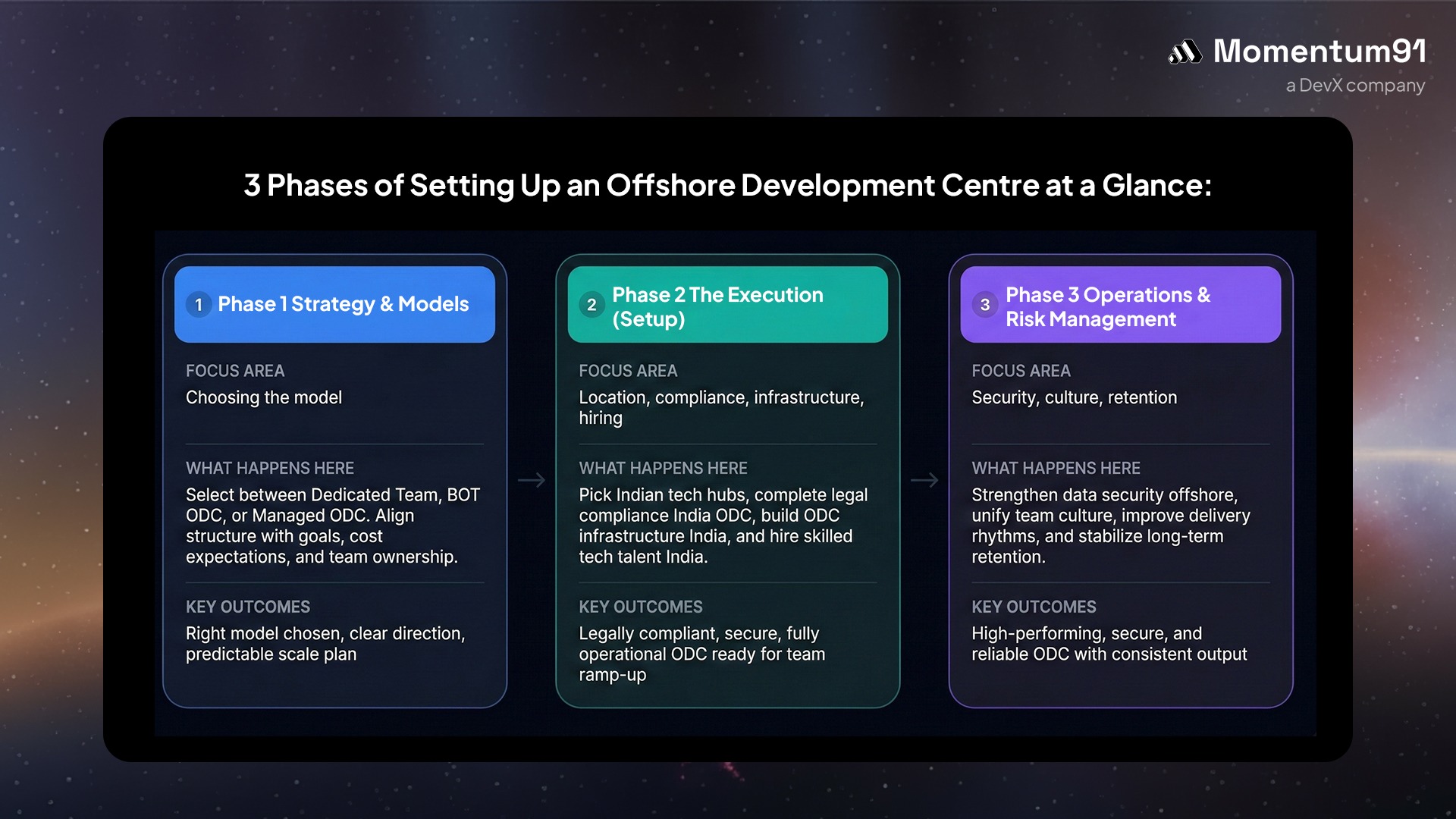
3 Phases of Setting Up an Offshore Development Centre at a Glance:
Accelerate Your ODC Setup in India with Momentum91
Momentum91 brings together engineering, AI, and product expertise to help you scale how to set up an offshore development centre quickly and confidently. With eight years of operational experience, a global infrastructure spread across 25 centers in 11 cities, and a talent network of more than 13,000 people, the company builds embedded teams that operate like an extension of your own.
Most teams go live fast, 95 percent of offshore development centres reach production readiness in under ten weeks. This includes PoC work, engineering scale-outs, and UX-driven product improvements aligned with your roadmap.
Our Key Strengths:
- AI-First Thinking: Every solution focuses on meaningful AI integration that supports product and engineering goals.
- End-to-End Development: Momentum91 covers the full flow of the offshore development centre setup process, from concept to delivery.
- Full-Stack Execution: Engineers, designers, and product specialists work in sync with your vision.
- Embedded Product Teams: Offshore units operate with the same clarity and ownership as onsite teams.
- Scalable Talent: Eines der zuverlässigsten Netzwerke Indiens ermöglicht schnelle Neueinstellungen und Teamwachstum sowohl an den Tier-1- als auch an Tier-2-Hubs.
Momentum91 verwandelt die Einrichtung eines Offshore-Entwicklungszentrums von einem komplexen Plan in einen strukturierten, zuverlässigen Betrieb. Das Ergebnis ist eine skalierbare Produktmaschine, die langfristiges Wachstum unterstützt, ohne Ihr Kerngeschäft zu beeinträchtigen.
Beginnen Sie Ihren Offshore-Bau mit Momentum91 und bringen Sie Ihr Team innerhalb weniger Wochen zum Laufen.
Fazit
Viele Unternehmen streben eine globale Präsenz an, haben aber mit inkonsistenten Einstellungen, unklaren Prozessen, schwacher Infrastruktur und langsamer Ausführung zu kämpfen. Diese Lücken machen aus einem einfachen Plan monatelange Verzögerungen. Die Teams verbringen mehr Zeit mit der Behebung betrieblicher Probleme als mit der Entwicklung des Produkts selbst. Die Führung verliert den Überblick, die Ingenieure arbeiten unstrukturiert und der Fortschritt gerät ins Stocken.
Der Schaden wächst schnell. Die Lieferung verlangsamt sich. Die Kosten steigen. Die Produktqualität sinkt. Die Fluktuation steigt, weil die Ingenieure keine Stabilität sehen. Das Unternehmen verliert die Kontrolle über seine eigene Roadmap, und die Offshore-Expansion wird zu einer Belastung statt zu einem Vorteil.
Momentum 91 behebt dies, indem es Ihnen ein klares, stabiles System für den Aufbau und Betrieb Ihres ODC bietet. Das Team kümmert sich um Einrichtung, Compliance, Infrastruktur und Talent, sodass Sie sich voll und ganz auf Produkt und Wachstum konzentrieren können.
Beginne deine ODC-Reise mit einem Partner, der schnell baut und Ihr Produkt voranbringt.
Häufig gestellte Fragen
1. Was ist der Kostenunterschied zwischen einem Standard-Outsourcing-Anbieter und einem ODC?
Ein Standardanbieter berechnet höhere gemischte Tarife, während ein ODC die langfristige Kontrolle bietet. Wenn Sie wissen, wie man ein Offshore-Entwicklungszentrum einrichtet, reduzieren Sie den Aufwand durch direktes Management, bessere Abstimmung und effiziente Teams. Unternehmen, die einen strukturierten Prozess zur Einrichtung eines Offshore-Entwicklungszentrums verfolgen, sparen oft 25— 40% und profitieren von höherer Datensicherheit und Stabilität im Offshore-Bereich.
2. Was sind die wichtigsten Arten von Offshore-Entwicklungszentren, die in Indien verfügbar sind?
Indien unterstützt Dedicated Teams, BOT-Zentren und Managed ODCs. Jedes Modell erfüllt unterschiedliche Ziele in ODC India 2025, von der Eigenverantwortung bis hin zur Geschwindigkeit. Wenn Sie wissen, wie ein Offshore-Entwicklungszentrum eingerichtet wird, wirkt sich die Wahl der richtigen Struktur auf die Qualität der Talente, die Kosten und die Einhaltung der Vorschriften aus. Mit diesen Modellen für Offshore-Entwicklungszentren können Sie problemlos über wichtige Knotenpunkte hinweg skalieren.
3. Wie lange dauert die Einrichtung des Offshore-Entwicklungszentrums in der Regel?
Die Zeitpläne hängen vom Standort, der Einstellung und der Einhaltung der Vorschriften ab. Mit einem Partner dauert die Einrichtung des Offshore-Entwicklungszentrums vier bis sechs Wochen, insbesondere in starken indischen Technologiezentren. Der Bau allein kann Monate dauern, da Sie sich um die Registrierung, die Einhaltung gesetzlicher Vorschriften in Indien, ODC und die Infrastruktur kümmern. Zu wissen, wie man ein Offshore-Entwicklungszentrum einrichtet, beschleunigt jede Phase.
4. Wie stelle ich IP-Sicherheit und Datensicherheit im Ausland sicher?
Sicherheit hängt von starken Verträgen, strengen Zugriffskontrollen und zuverlässigen Tools ab. Die Teams verwenden MFA, VPNs und Genehmigungsregeln, die den Standards von ODC Infrastructure India entsprechen. Wenn Sie wissen, wie Sie ein Offshore-Entwicklungszentrum richtig einrichten, verbessern Sie den Codeschutz und die Datensicherheit im Ausland, insbesondere für Produkte, die regulierte Branchen mit globalen Erwartungen bedienen.
5. Was sind die aufstrebenden indischen Technologiezentren außerhalb von Bengaluru?
Städte wie Hyderabad, Pune, Chennai, NCR, Kochi, Indore und Ahmedabad expandieren schnell. Diese indischen Technologiezentren bieten starke technische Talente in Indien, niedrigere Kosten und eine bessere Kundenbindung. Wenn Sie wissen, wie Sie in diesen Regionen ein Offshore-Entwicklungszentrum einrichten, können Sie stabile Teams aufbauen und die langfristige Expansion in den wachsenden GCC-Markt Indien unterstützen.
The inbox update you’ll never want to skip
A quick catch-up with ideas, wins, and tips worth stealing, straight to your inbox every week.
The easiest way to reach us.
Share your details and we’ll get back within 24 hours.
Blogs

Eine Fülle von Einsichten,alles an einem Ort
Von der Strategie bis zur Ausführung. All die großen Ideen, praktischen Leitfäden und frischen Perspektiven, die Ihnen helfen, mit Zuversicht zu skalieren
E-Books
Umfassende Leitfäden, die den geschäftlichen und technologischen Wandel aufschlüsseln und Ihnen helfen, klar zu führen.

Sprechstunden
Ihr direkter Draht zu unseren Experten. Praktische Tipps zur Skalierung, genau dann, wenn Sie sie brauchen.

Berichte
Datengestützte Perspektiven darüber, in welche Richtung sich Branchen entwickeln, geben Ihnen die nötige Weitsicht, um mutigere Schritte zu unternehmen.
Mitteilungsblatt
Ein kurzer Überblick über Ideen, Gewinne und Tipps, die es wert sind, gestohlen zu werden, und zwar jede Woche direkt in Ihrem Posteingang.
.avif)
.avif)
Ihr Offshore-Entwicklungszentrum, richtig gemacht
Unser bewährtes Modell bietet Zugang zu erstklassigen globalen Talenten, Unternehmensinfrastruktur und vollständiger Einhaltung gesetzlicher Vorschriften.
Starte jetzt