IT Outsourcing Vs IT Offshoring: 5 Key Differences to Help You



%20IT%20Outsourcing%20Vs%20IT%20Offshoring_%205%20Key%20Differences%20to%20Help%20You.jpg)
Companies keep searching for the best way to scale tech teams, yet many still confuse IT outsourcing with offshoring. This mix-up creates planning errors that slow projects and increase costs. You work with IT outsourcing when you want a vendor to handle defined tasks. You use offshoring when you build your own team in another country. Both models support growth, but they solve different problems.
Here’s the part most leaders miss: one model decides who does the work, and the other decides where the work happens. That difference shapes control, expenses, talent retention, and long term stability.
A partner like Momentum91 helps companies avoid this mix-up by setting up the right structure from day one so teams don’t lose time fixing preventable issues later. This guide breaks down the five key gaps so you can pick the setup that fits your 2025 plans with clarity.
Difference 1: Control & Ownership (The Driver’s Seat)
Control is one of the biggest shifts you’ll notice when comparing IT outsourcing, offshoring, and nearshoring IT services. The way you steer the work changes the entire delivery experience.
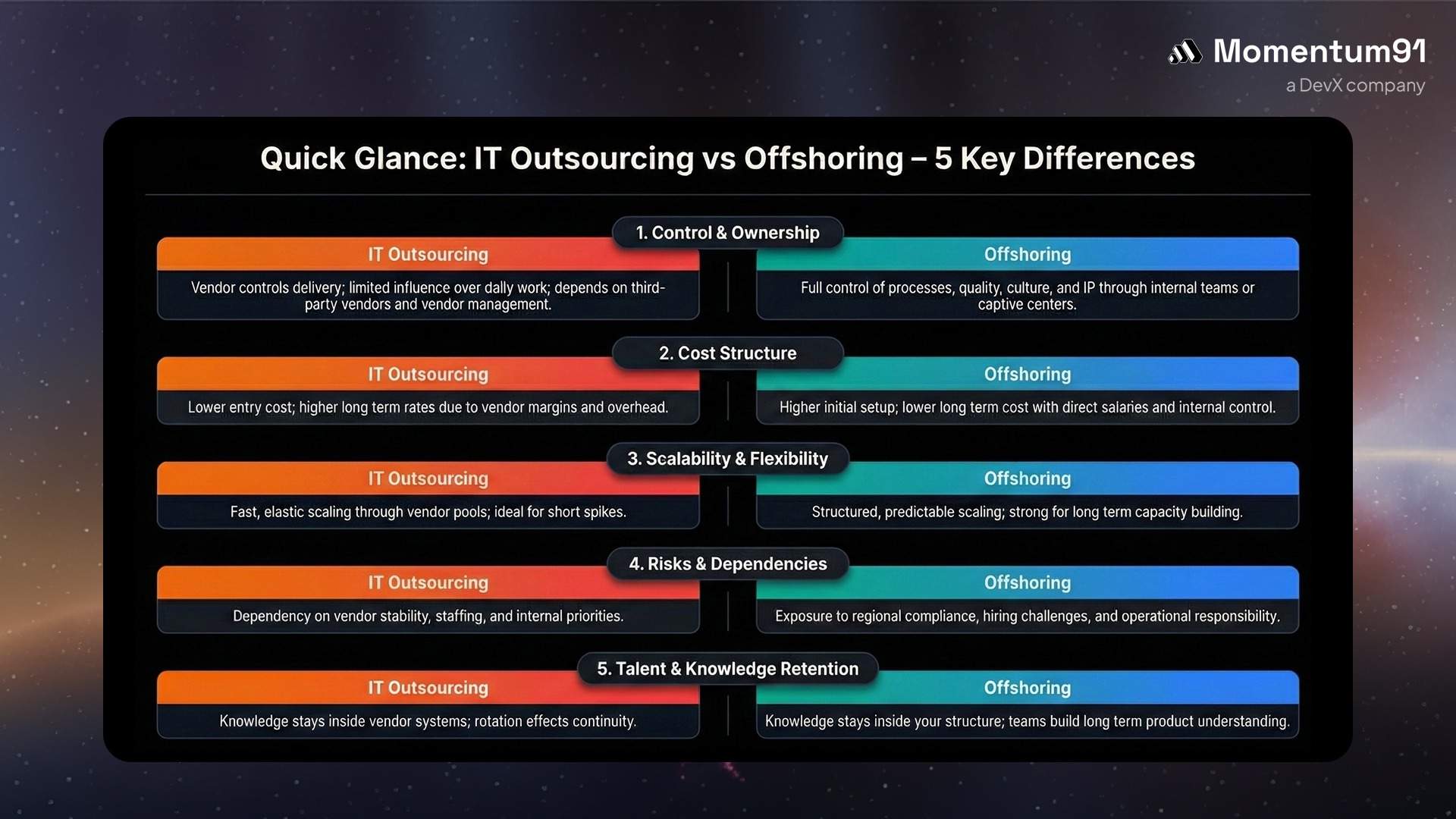
A) Outsourcing: Lower Direct Control
With IT outsourcing, you set targets and timelines, and the vendor decides how the work happens. They choose tools, staffing, and workflow. You review outcomes, not internal steps. This works for support tasks, testing, maintenance, or overflow work where speed matters more than deep involvement.
Since execution sits with third-party vendors and their vendor management layers, your influence stays limited beyond contract terms. Mentioning IT outsourcing vs offshoring helps teams avoid mixing expectations.
B) Offshoring: Full Control and Ownership
Offshoring gives you a dedicated team that follows your processes, sprint rhythm, quality checks, and internal rules. Companies build captive centers or partner with operators who handle HR and compliance but leave the direction to you.
You shape culture, set coding standards, review work daily, and protect IP without depending on vendor-led decisions. This difference matters because the level of control you take now affects stability, talent depth, and long term output as your team grows.
Difference 2: Cost Structure & Financial Impact
Cost decisions drive long term stability. That’s why the financial model behind IT outsourcing, offshoring, and nearshoring IT services shapes how your team grows.
A) Outsourcing: Operating Expense Model
With IT outsourcing, you avoid setup costs and pay only for service output. Vendors take care of hiring, tools, and delivery. This keeps your starting effort low but raises long term expenses. Rates include vendor overhead, admin layers, and vendor management fees.
What makes outsourcing feel lighter at the start:
- No recruitment cycles
- No office or IT setup
- Work begins fast
- Flexible resource allocation
These benefits work best for short projects. Teams often use IT outsourcing vs offshoring comparisons to decide if higher monthly rates still make sense.
B) Offshoring: Blended CapEx and OpEx
Offshoring needs more effort at the start. You build your own structure through captive centers or partner-led setups. You handle hiring, compliance, and onboarding. After the team starts running, monthly costs drop because you pay local salary bands instead of third-party vendors.
Why offshoring becomes cost-efficient later:
- Lower ongoing salaries
- Direct control over tools and roles
- No vendor margin
- Knowledge stays internal
This model suits long term product work where talent depth and cost predictability matter. Your cost model shapes both your speed today and your stability later, so match it with the duration and goals of your project.
Difference 3: Scalability & Flexibility
Scaling looks very different when you compare IT outsourcing, offshoring, and nearshoring IT services. Each model supports growth in its own way and affects how fast you can move when your workload changes.
A) Outsourcing: Fast and Elastic Scaling
With IT outsourcing, vendors can add people quickly because they rely on trained teams, hiring networks, and third-party vendors. This gives you urgent support without dealing with internal recruitment.
Where this outsourcing business model helps:
- You need instant team expansion
- Project demand shifts often
- You want zero hiring cycles
- You prefer flexible terms with strong vendor management
Many teams use IT outsourcing vs offshoring comparisons to decide whether elastic scaling is enough for long term work.
B) Offshoring: Structured and Predictable Scaling
Offshoring grows through stable hiring inside captive centers or partner-supported setups. You build long term capacity with predictable onboarding and direct control. Teams stay consistent, and knowledge remains inside your structure instead of passing through third-party vendors.
Where offshoring stands out:
- You want stable delivery
- You want your own processes
- You value internal knowledge
- You want reliable global talent access
Scaling is not only about speed. It’s about choosing the structure that supports your workload without creating gaps later.
Difference 4: Risks & Dependencies
Every model carries its own risk profile. Knowing how IT outsourcing, offshoring, and nearshoring IT services behave under pressure helps you avoid interruptions and keep delivery stable.
A) Outsourcing: Vendor Dependency Risks
With IT outsourcing, you depend on a vendor’s ability to maintain quality, staffing, and stability. If they face internal issues, your work slows or stops. You rely on their workflows, senior oversight, and vendor management structure. This creates a dependency you can’t ignore.
Common risks in this setup:
- Sudden talent changes inside third-party vendors
- Limited visibility into daily work
- Delays caused by internal bottlenecks
- Reduced influence over quality decisions
Teams often use IT outsourcing vs offshoring comparisons to understand when these dependencies become a long term concern.
B) Offshoring: Operational and Country-Level Risks
Offshoring brings a different set of risks. You handle HR, legal compliance, and process stability yourself. You also depend on the local environment around your captive centers, including regulations and talent availability. If the region faces political or operational issues, your team may slow down.
Typical offshoring risks:
- Compliance changes
- Local hiring challenges
- Regional disruptions
- Increased responsibility for internal continuity
Each model carries its own weight, so you need to match the risk level with how your team operates and what you expect from long term delivery.
Difference 5: Talent & Knowledge Retention
How your team holds on to knowledge affects delivery speed and long term stability. The way IT outsourcing, offshoring, and nearshoring IT services handle this part can shape your entire tech roadmap.
A) Outsourcing: Knowledge Lives Inside the Vendor’s Structure
With IT outsourcing, your project depends on people who work across different accounts. When they rotate or move, some context leaves with them. Even with documentation, you still rely on third-party vendors to maintain continuity.
Their internal priorities, training cycles, and vendor management rules decide how much knowledge stays stable.
You usually see:
- Moves between accounts
- Uneven context transfer
- Limited process alignment
- Reliance on vendor-side systems
This is why teams often compare IT outsourcing vs offshoring before committing to long term work.
B) Offshoring: Knowledge Grows Inside Your Own Structure
Offshoring builds a steady base. Your team works inside your workflows, not a vendor’s rotation model. Whether you use captive centers or partner-supported hiring, people stay longer and understand the product in depth.
They learn your tools, culture, and goals, which keeps critical information inside your company instead of another organization’s pipeline.
You gain:
- Consistent teams
- Direct control over training
- Clear ownership
- Stronger use of global talent access
This difference shifts how fast your team learns, improves, and supports long term projects.
Quick Glance: IT Outsourcing vs Offshoring — 5 Key Differences
How Momentum91 Bridges the Operational Gap
Momentum91 brings together strong AI, development, and design capability to help you scale with confidence. With 8 years of experience, a global setup across 25 centers and 11 cities, and a talent network of 13,000+ people, we build embedded teams that work like an extension of yours.
We move quickly, with most teams going live in under five weeks. Our support ranges from early PoC builds to complete software programs, product improvements, and UX planning. This helps companies avoid the confusion that often happens with IT outsourcing setups and offshoring structures.
Key Strengths:
- AI-First Thinking: Practical, contextual use of AI to improve product delivery.
- End-to-End Development: Clear coverage from idea to working software.
- Full-Stack Execution: Engineers, designers, and product thinkers all aligned to one direction.
- Embedded Product Teams: Offshore teams that work in your tools, hours, and routines.
- Scalable Talent: Fast hiring through reliable partner networks and strong local presence.
Momentum91 helps companies move from theory to working teams by giving them the control of offshoring without the heavy setup and the speed of outsourcing without the instability.
Connect with Momentum91 and scale without guesswork.
Conclusion
IT outsourcing and offshoring solve different needs, yet many teams still treat them as the same approach. One gives you vendor-led delivery, the other gives you long term control. When this difference isn’t clear, teams face delayed work, unstable talent, rising costs, and constant restarts. These issues stack up over time and slow down products that should have moved faster.
The real risk shows up when the wrong model locks you into a setup that doesn’t match your roadmap. Work becomes inconsistent, knowledge slips away, and teams lose direction just when pressure increases.
Momentum91 helps companies avoid these traps by giving them a setup that blends speed, ownership, and stability. You get offshore teams that work like your own, without dealing with operational layers that often complicate both models.
Talk to Momentum91 and get clarity for your build.
FAQs
1. Can I combine IT outsourcing and offshoring?
Yes. Many companies blend IT outsourcing for flexible tasks with offshoring for long term control. This mix reduces risk, improves stability, and gives you access to global talent access without relying fully on third-party vendors. A hybrid structure makes IT outsourcing vs offshoring decisions easier to manage.
2. Is nearshoring IT services more expensive than offshoring?
Nearshoring usually costs more than offshoring because nearby regions have higher salary ranges. Still, nearshoring IT services gives smoother communication, shared working hours, and faster handoffs. It’s a strong choice when collaboration matters more than cost savings inside captive centers or vendor-led setups.
3. What are the hidden costs of outsourcing business models?
With IT outsourcing, hidden costs appear through change requests, onboarding delays, tool alignment, vendor management overhead, and knowledge loss during rotations inside third-party vendors. These costs add up on long projects, so teams compare IT outsourcing vs offshoring before choosing a long term structure.
4. How does control and ownership work in a BOT model?
A BOT model starts with a partner building and running your offshore setup. After operations stabilize, they transfer the team, tools, and captive centers to you. This reduces early risk while giving long term control and stable talent without full dependence on IT outsourcing structures.
The inbox update you’ll never want to skip
A quick catch-up with ideas, wins, and tips worth stealing, straight to your inbox every week.
The easiest way to reach us.
Share your details and we’ll get back within 24 hours.
Blogs
A plethora of insights,all in one place
From strategy to execution. All the big ideas, practical guides & fresh perspectives that’ll help you scale with confidence
Ebooks
Comprehensive guides that break down the shifts in business and technology, Helping you lead with clarity.

Office Hours
Your direct line to our experts. Practical advice for scaling, right when you need it.
Reports
Data-backed perspectives on where industries are headed, giving you the foresight to make bolder moves.
Newsletter
A quick catch-up with ideas, wins, and tips worth stealing, straight to your inbox every week.
.avif)
Podcasts
Conversations where you get to know everything from the ones who know it best.
.avif)
Hire Offshore Developers, Right Now!
Access top-tier global talent, enterprise infrastructure, and complete regulatory compliance through our proven model.
Start Now