Vollständiger Leitfaden zum IT-Infrastrukturmanagement für Saudi-Arabien



Saudi Arabien hat investierte über 100 Milliarden US-Dollar in die digitale Transformation unter Vision 2030. Die Ergebnisse sehen auf dem Papier beeindruckend aus. Viele Unternehmen in Riad sehen sich jedoch mit einer anderen Realität konfrontiert: einer veralteten Infrastruktur, die die Kosten in die Höhe treibt 30-40%, Systeme, die wöchentlich ausfallen, und Sicherheitslücken, die sie zunehmenden Cyberbedrohungen aussetzen.
Ihre Konkurrenten wechseln zu Cloud-Plattformen, setzen KI-Workloads ein und erfüllen strenge Compliance-Anforderungen. Sie stecken in der Verwaltung veralteter Systeme fest, die Budgets belasten und das Wachstum verlangsamen. IT-Infrastrukturmanagement in Saudi-Arabien: Riyadh Unternehmen brauchen einen praktischen Ansatz, der funktioniert.
Dieser Leitfaden von Momentum 91 umfasst die Bewertung der Infrastruktur und die Ausrichtung der Cloud-Strategie auf Vision 2030 IT-Infrastrukturziele, NCA-Compliance, KI- und Edge-Computing-Bereitschaft, Kostenoptimierung und ein klarer Implementierungsfahrplan.
Schritt 1: Bewertung des aktuellen Reifegrads der Infrastruktur
Du kannst nicht reparieren, was du nicht verstehst. Bevor Sie in die Cloud wechseln oder Systeme aktualisieren, benötigen Sie ein klares Bild von Ihrem aktuellen Status.
1. Vervollständigen Sie Ihr Infrastrukturinventar
Beginnen Sie mit einer vollständigen Bestandsaufnahme Ihres IT-Infrastrukturmanagements in der Umgebung von Saudi-Arabien in Riad. Dokumentieren Sie jedes System, jede Arbeitslast, jeden Datenfluss und jede Abhängigkeit. Beziehen Sie Schatten-IT-Ressourcen mit ein, die Abteilungen ohne Ihr Wissen verwalten.
2. Berechnen Sie technische Schulden und Kosten
Die Wartung von Servern, die älter als fünf Jahre sind, kostet 40% mehr als die Wartung neuerer Hardware. Angenommen, Sie betreiben 50 Server und 20 sind sechs Jahre alt. Die Wartung kostet jährlich SAR 5.000 pro Server.
Neuere Server kosten 3.000 SAR pro Server. Ihre alte Infrastruktur verschwendet jährlich 40.000 SAR. Überprüfen Sie die Softwareversionen und identifizieren Sie nicht unterstützte Systeme. Diese stellen Sicherheitsrisiken für das IT-Infrastrukturmanagement im Betrieb in Riad dar.
3. Überprüfen Sie die Sicherheits- und Compliance-Lücken
Ordnen Sie Ihre Sicherheitslage den 108 Kontrollen von NCA ECC-2:2024 zu. Prüfen Sie die Funktionen für Zugriffskontrollen, Verschlüsselung, Protokollierung und Reaktion auf Vorfälle. Prüfen Sie die Lücken in der PDPL-Konformität. Können Sie die Behörden innerhalb von 72 Stunden nach einem Verstoß benachrichtigen? Der NCA-Status Ihrer IT-Infrastruktur hängt von diesen Antworten ab.
4. Erstellen Sie Ihr Prioritäts-Framework
Erstelle drei Listen: jetzt korrigieren (kritische Sicherheitslücken, Compliance-Verstöße), bald reparieren (Leistungsengpässe, Systeme nähern sich dem Ende ihrer Lebensdauer) und schrittweise modernisieren (Legacy-Anwendungen bereit für Einführung der Cloud-Infrastruktur und Vision 2030 Migration).
Nach Abschluss Ihrer Bewertung sind Sie bereit, eine Cloud-Strategie zu entwickeln, die den regulatorischen Anforderungen Saudi-Arabiens entspricht.
Schritt 2: Cloud- und Hybrid-Infrastrukturstrategie (Ausrichtung der Vision 2030)
Allein in diesem Zeitraum erteilte das Handelsministerium 1.759 Cloud-Computing-Genehmigungen. Ihre Strategie Vision 2030 für die Einführung einer Cloud-Infrastruktur muss ein ausgewogenes Verhältnis zwischen Geschwindigkeit und Compliance aufweisen.
1. Verstehen Sie den Kontext des Cloud-Wachstums
Das Cloud-Computing Der Markt in Saudi-Arabien wurde getroffen 14,55 Milliarden US-Dollar im Jahr 2024 und werden bis 2033 38,23 Milliarden US-Dollar erreichen. SaaS gilt 44,7% Marktanteil. Öffentliche Cloud-Konten für 66,4% der Implementierungen, aber die Einführung einer hybriden IT-Infrastruktur in Saudi-Arabien nimmt zu 16,9% jährlich. Unternehmen wollen Flexibilität.
2. Erfüllen Sie die Anforderungen an die Datenresidenz
Das National Data Management Office (NDMO) kümmert sich jetzt um die Anforderungen an die Datenlokalisierung. PDPL schreibt vor, dass sensible personenbezogene Daten in Saudi-Arabien bleiben, sofern keine bestimmten Bedingungen erfüllt sind.
Sie können nicht einfach einen Cloud-Anbieter auswählen. Ihre Entscheidungen über das IT-Infrastrukturmanagement in Saudi-Arabien, Riad, müssen die Datensouveränität beinhalten.
3. Wählen Sie von Saudi-Arabien zugelassene Cloud-Anbieter
AWS hat seine Region Saudi-Arabien gegründet und baut die Kapazitäten weiter aus. Microsoft schloss den Bau seines Rechenzentrums in der Region im Dezember 2024 ab. Google Cloud eröffnete seine Region Dammam im August 2024 mit Datensouveränität und KI-Lösungen.
Oracle hat investiert 1,5 Milliarden US-Dollar für die dritte Public-Cloud-Region in Riad. Huawei Cloud war der erste Anbieter, der die staatlichen Datensicherheitsrichtlinien vollständig einhielt.
4. Entwerfen Sie Ihr Hybridmodell
Bewahren Sie sensible Regierungsdaten und latenzkritische Anwendungen auf (unter 5 ms erforderlich) und ältere Systeme mit hohem Risiko vor Ort. Verschieben Sie Entwicklungs-/Testumgebungen, SaaS-Anwendungen, Backup/DR und saisonale Workloads in die Cloud. Außerbetriebnahme redundanter Systeme und nicht unterstützter Software
Ihre IT-Infrastrukturoptimierung Der Ansatz der Unternehmen in Riad sollte Infrastructure as Code unter Verwendung von Terraform oder Wolkenbildung aus Gründen der Konsistenz. Entwerfen Sie nach cloudnativen Prinzipien, wo es sinnvoll ist.
Nachdem Ihre Cloud-Strategie definiert ist, müssen Sie sie ordnungsgemäß sichern und die gesetzlichen Anforderungen erfüllen.
Schritt 3: Sicherheits- und Compliance-Infrastruktur (NCA-fähig)
Die NCA hat ihren Rahmen im Dezember 2024 mit echten Durchsetzungsmaßnahmen aktualisiert. Die Strafen für Verstöße belaufen sich nun auf 25 Millionen SAR.
1. Verstehen Sie die Anforderungen von NCA ECC- 2:2024
NCA ECC- 2:2024 reduzierte die Kontrollen von 114 auf 108 für eine bessere Effizienz. Der Rahmen deckt Regierungsstellen, kritische nationale Infrastrukturen, Finanzinstitute und private Einrichtungen ab, die CNI beherbergen. Es entspricht dem NIST Rahmen für Cybersicherheit und ISO/IEC 27001.
Hier ist die große Änderung: ALLE Positionen im Management der Cybersicherheitsinfrastruktur müssen jetzt mit qualifizierten saudischen Staatsangehörigen besetzt werden, nicht nur mit leitenden Positionen.
2. Implementieren Sie die wichtigsten Sicherheitskontrollen
Richten Sie ein rund um die Uhr verfügbares Security Operations Center für kontinuierliche Überwachung und Bedrohungserkennung ein. Implementieren Sie die mehrstufige Authentifizierung in Ihrem gesamten Unternehmen. Nutzen Sie privilegiertes Zugriffsmanagement und rollenbasierte Zugriffskontrolle.
Daten während der Übertragung verschlüsseln (TLS 1,3+) und in Ruhe (AES-256). Richten Sie zentralisiertes SIEM für die Protokollaggregation mit einer Mindestaufbewahrungsdauer von 5 Jahren ein. Führen Sie vierteljährliche Schwachstellenscans durch und beheben Sie kritische Sicherheitslücken innerhalb von 30 Tagen.
3. Erfüllen Sie die PDPL-Konformitätsstandards
PDPL verlangt eine 72-stündige Benachrichtigung der SDAIA, wenn die Verletzung ein erhebliches Risiko darstellt. Ernennen Sie einen Datenschutzbeauftragten, wenn Sie eine öffentliche Einrichtung sind, Daten als Ihre Haupttätigkeit verarbeiten oder mit sensiblen Daten umgehen.
Antworten Sie innerhalb von 30 Tagen auf Datenzugriffs- und Löschanfragen. Bewahren Sie Ihr Verzeichnis der Verarbeitungsaktivitäten nach Ende der Verarbeitung 5 Jahre lang auf. Grenzüberschreitende Datenübertragungen benötigen SDAIA Bewertung der Angemessenheit.
4. Erstellen Sie Ihre Compliance-Checkliste
Erstellen Sie einen Plan zur Reaktion auf Vorfälle mit definierten Rollen und Eskalationsverfahren. Testen Sie vierteljährlich Backup und Disaster Recovery. Für die Einhaltung der Anforderungen Ihrer IT-Infrastruktur (NCA) ist ein Recovery-Point-Objective unter 4 Stunden und für kritische Systeme ein Recovery-Time Objective unter 8 Stunden erforderlich.
Führen Sie jährlich Schulungen zum Sicherheitsbewusstsein und vierteljährlich Phishing-Simulationen durch. Wenn die Sicherheit gesperrt ist, können Sie die Infrastruktur für KI- und Edge-Computing-Workloads sicher skalieren.
Schritt 4: Skalierung der Infrastruktur für KI-, IoT- und Edge-Workloads
Smart-City-Projekte führen zu massiven Infrastrukturanforderungen in ganz Saudi-Arabien. NEOM only need systems, the video analysis, sensor data and decisions in time in large measure.
1. Anforderungen an die Infrastruktur intelligenter Städte
NEOM-Infrastrukturtechnologieprojekte erfordern viel Rechenleistung. DataVolt unterzeichnete im Januar 2025 eine 5-Milliarden-Dollar-Partnerschaft zum Bau von KI-Rechenzentren mit einer Kapazität von 1,5 GW. The first phase goes 2028 in operation. The NEOM Investment Fund supports MemryX Edge-KI-Chips, die weniger als 10% der Leistung verbrauchen, die herkömmliche GPUs benötigen.
Anfang 2025 hatten sich 28,5 Millionen Menschen auf den Plattformen Absher und Nafath angemeldet und über 470 digitale Dienste zugegriffen. Your IT infrastructure management in Saudi Arabia, Riad, must support this growth.
2. Buy a KI and ML infrastructure on
Für das KI-Training sind NVIDIA H100-Cluster und benutzerdefinierte ASICs für die Inferenz erforderlich. Ihre Racks müssen jeweils 10—50 kW verarbeiten, im Vergleich zu den gängigen 5—7 kW-Setups. Das bedeutet Flüssigkeitskühlsysteme. Storage requires NVME-All-Flash-Arrays for Data Lakes.
Networks need a bandwidth of over 100 Gbit/s with structures with lower latence for distributed training. Center3 strebt eine Gesamtkapazität des Rechenzentrums von 1 GW bis 2030 an, wobei zusätzliche Investitionen in Höhe von 10 Milliarden US-Dollar erforderlich sind.
3. Set ready Edge-Computing-Lösungen
The Edge Computing infrastructure processed data local with a latence from under 5 ms. This is major for autonome vehicles and industrial control systems. Sell you microrechenzentren ready (5-10 kW) und Randpositionen. Verbinden Sie sie mit regionalen Aggregationspunkten und synchronisieren Sie sie dann mit der zentralen Cloud. Saudi Arabiens The 5G infrastructure will reach to 2033 4.81 billion US dollar.
4. Unterstützen Sie branchenspezifische Workloads
The cloud spending in health system to 17,4% jährlich für Telemedizin und KI-Diagnostik. BFSI hält 27,4% des Cloud-Computing-Marktanteils in Saudi Arabia for Core Banks and Betrugserkennung.
The production uses KI for the ready maintenance. The 1.3 billion SAR teures automation project by Samsung C&T by NEOM reduzierte die manuelle Arbeit um 80%. Der E-Commerce im Einzelhandel stieg im April 2024 um 57% auf 23,27 Mrd. STERN.
All diese Infrastruktur kostet Geld. Sie müssen die Ausgaben verfolgen und den ROI nachweisen.
Schritt 5: Messung des ROI und Verwaltung der IT-Kosten
Sie benötigen einen Überblick darüber, was Ihr IT-Infrastrukturmanagement in Saudi Arabia, Riad, tatsächlich kostet und welche Renditen Sie erzielen. The Cloud Program of the Government of DEEM sparte to 2023 5 billion SAR, when the issues were properly monitoring.
1. Verfolgen Sie wichtige Leistungskennzahlen
Messt the prozentsatz of availability for your environment. Nachverfolgen bedeutet, wie lange es dauert, bis Vorfälle behoben sind. Calculate the total operating costs, including infrastructure, operation, license and support.
Überwachen Sie Ihr Cloud-Computing. Saudi Arabia is for workload and business unit. Check the capacity auslastungsrates. Unter 70% Bedeutet, dass Sie Geld für ungenutzte Ressourcen verschwenden. Previous 80% Sie sind gefährdet bei Verkehrsspitzen.
2. Implementieren Sie das FinOps Framework
Create dashboards that show the ausgaben for it infrastructure management in Riad in Echtzeit by department and project. Passe the size your cloud instances an. Viele Unternehmen verwenden übergroße Server, die überlastet sind 40-50% ihre Budgets.
Use Reserved Instances for vorhersehbare Workloads, to reduce the costs bis zu 70%. Apply budget warnungen to the teams know if they to much output. Sie zeichnen jede Ressource richtig auf, damit Sie verfolgen können, wohin das Geld fließt.
3. Automatisieren Sie den Betrieb
Infrastruktur als Code macht manuelle Bereitstellungsfehler überflüssig und beschleunigt die Bereitstellung. The automatic monitoring detected problems before they carry to failure. Optimierung der IT-Infrastruktur: Unternehmen in Riad reduzieren den Betriebsaufwand 30-40% by Automation. Ihr Team verbringt weniger Zeit mit sich wiederholenden Aufgaben und mehr Zeit mit strategischer Arbeit.
4. Calculate the business value
Einführung der Cloud-Infrastruktur Die Vision 2030 sorgt für schnellere Anwendungsbereitstellungen, eine verbesserte Entwicklerproduktivität und ein geringeres Risiko. This benefits at the analysis of the ROI of IT infrastructure in Saudi Arabia.
Kurzanleitung: 5 Schritte zum IT-Infrastrukturmanagement

Harte Kosteneinsparungen sind wichtig, aber die Produktivitätssteigerungen übersteigen sie oft. Sie haben jetzt die Kennzahlen. So führen Sie die Transformation aus.
Umsetzungsfahrplan (Saudi Arabia im Fokus)
Sie haben die Bewertung, Strategie und Kennzahlen. Sie benötigen jetzt einen praktischen Zeitplan, der für das IT-Infrastrukturmanagement der Teams in Riad in Saudi-Arabien funktioniert.
Phase 1: Bewertung und Priorisierung (Monat 1—2)
Sie beginnen mit einer vollständigen Überprüfung Ihres aktuellen Zustands:
- Week 1-2: Voll ständiges Infrastructure Inventar (Systems, Applications, Data Flows, Abhängigkeiten)
- Wochen 3-4: Sie führen eine Sicherheitsbewertung anhand von NCA ECC- 2:2024 und PDPL-Compliance-Audits durch
- Wochen 5-6: Capacity planning and workload analysis. Identifizieren Sie Anwendungen für die Einführung der Cloud-Infrastruktur für die Migration von Vision 2030.
- Wochen 7-8: Create a prioriized roadmap with quick reach, mittelfristigen projects and long-term initiatives
Ergebnisse: Bewertungsbericht zum aktuellen Stand, Lückenanalyse, 24-Monats-Roadmap with budget estimated.
Phase 2: Hybrid-Cloud-Grundlage (Monate 3—6)
Buy your cloud base and basic security on:
- Monat 3: Richten Sie Cloud-Landzonen (Netzwerke, Identität, Sicherheitsbasislinien) mit in Saudi Arabien erlaubten Anbietern ein
- Monates 3-4: Plant the SOC functions ready (SIEM, EDR, scan schwachstellen-Scannen). Implementieren Sie unternehmensweit eine mehrstufige Authentifizierung.
- Monates 4—5: Migrieren Sie unkritische Workloads auf Cloud-Computing-Plattformen in Saudi-Arabien (Entwicklungs-/Testumgebungen, Backup/DR). Validieren Sie die Einhaltung der Datenresidenzen.
- Monates 5-6: Implementieren Sie Ihre Infrastruktur als Code-Vorlagen und FinOps-Dashboards
Regel: Migrieren Sie niemals mehr als 20-25% der Kernworkloads gleichzeitig. Services: Operating ready hybrid cloud environment, basic security controls.
Phase 3: Modernisierung (Monate 6—12)
Transformieren Sie ältere Anwendungen und sorgen Sie für vollständige Compliance:
- Monates 6-8: Refaktorisieren Sie vorrangige Anwendungen für die Cloud (Containerization, falls zutreffend)
- Monates 8—10: Implementieren Sie eine umfassende Überwachung (APM, Infrastructure Monitoring, Protocol Management)
- Monates 10—12: Implementieren Sie erweiterte Sicherheit (CASB, DLP, Identity Governance). Vollständige PDPL-Konformität (Ernennung zum Datenschutzbeauftragten, Datenzuordnung, Datenschutzrichtlinie)
Sie konzentrieren sich auf die kontinuierliche Optimierung der IT-Infrastruktur für Unternehmen in Riad durch richtige Dimensionierung und Erkennung von Kostenanomalien. Ergebnisse: Modernisiertes Anwendungsportfolio, umfassende Beobachtbarkeit.
Phase 4: KI- und Edge-Erweiterung (Jahr 2)
Scaler the extended functions for the IT infrastructure management in Saudi Arabia in Riad:
- Q1: Plant Edge-Computing-Infrastruktur an strategischen Standorten (Städte, Industriegebiete) bereit. Spot her 5G-Connectivity.
- Q2-Q3: Create a KI/ML platform (GPU-Cluster, Data Lakes, MLOPS-Pipelines). Pilot application cases for KI (predictive maintenance, video analysis)
- Q4: Skalieren Sie erfolgreiche KI-Workloads. Extended the Edge-Projections. Optimize the costs by automation.
results: KI/ML platform for production, operational edge infrastructure, designed automation framework.
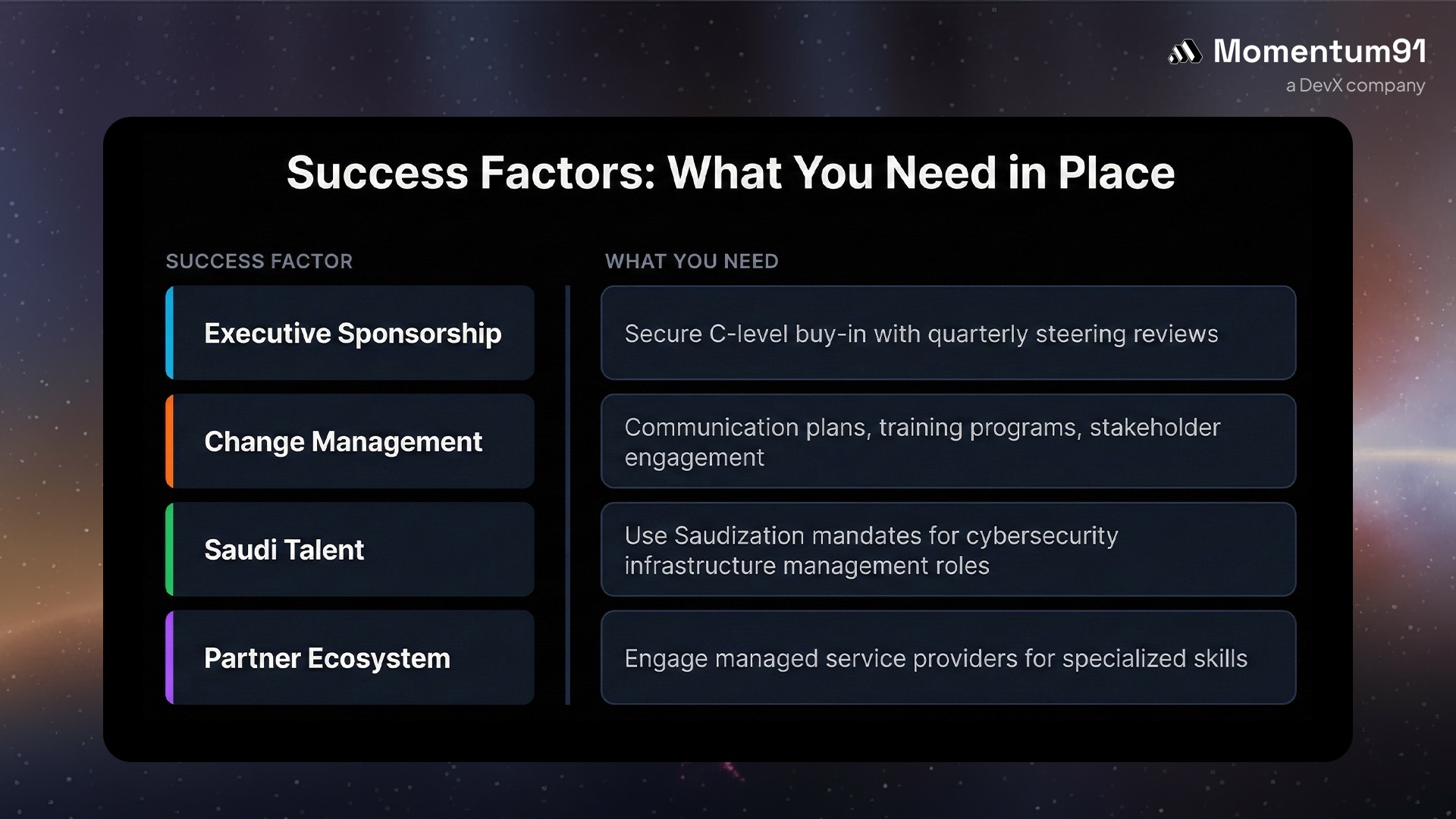
Critical success factors
Your transformation requires more as technology:
Sind Sie bereit, spezifische Fragen zu Ihrer Infrastruktur für die digitale Transformation in Saudi-Arabien zu beantworten? Sie müssen Folgendes wissen.
How Momentum91 Your Infrastructure targets of Vision 2030 supports
Momentum 91 vereinte fundiertes Fachwissen in den Bereichen KI, Entwicklung und Infrastruktur, um Ihnen zu helfen, das IT-Infrastrukturmanagement im saudi-arabischen Betrieb schnell und effizient zu skalieren. With 8 years experience and an global infrastructure, the 25 Centres and 11 cities, and a talent pool of 13.000+ Menschen, wir stellen eingebettete Full-Stack-Teams bereit, die sich wie ihre eigenen fühlen.
We move us quickly, with 95% der Teams zur Modernisierung der IT-Infrastruktur wurden in weniger als zehn Wochen live geschaltetund wir decken alles ab, von der Einführung der Cloud-Infrastruktur und der Planung der Vision 2030 bis hin zur Implementierung, dem Management der Cybersicherheitsinfrastruktur und der laufenden Optimierung.
Die wichtigsten Stärken:
- KI-orientiertes Denken: Innovation beginnt mit einem durchdachten IT-Infrastrukturmanagement und der Integration in Saudi Arabia, die KI-Workloads und Edge-Computing unterstützt.
- Ende-zu-Ende-Entwicklung: Von der Bewertung bis zur Bereitstellung deckt Momentum91 alle Phasen der IT-Infrastrukturoptimierung und der Transformation des Unternehmens in Riad ab.
- Full-Stack-Ausführung: Engineers, Cloud-Architects and Security Specialists are all in Your Vision of the digital transformation infrastructure in Saudi Arabia.
- Integrierte Produktteams: The teams for the off-shore it infrastructure management in Riad work as before location and support your NCA compliance and PDPL requirements.
- Skalierbares Talent: Schnelles Teambuilding, unterstützt durch eines der zuverlässigsten Partnernetzwerke Indiens mit Fachwissen in den Bereichen Cloud-Computing, Plattformen in Saudi-Arabien und hybride IT-Infrastrukturmodelle in Saudi-Arabien.
Sie erfahren, wie Momentum91 die Herausforderungen der Vision 2030 IT-Infrastruktur in skalierbare Lösungen umwandelt und Ihnen hilft, intelligenter, schneller und stärker zu werden.
Kontaktieren Sie Momentum91 for a free infrastructure evaluation and a maßgeschneiderte roadmap.
Fazit
IT infrastructure management The business activity in Riad in Saudi Arabia, either they keep with the Vision 2030 step or been back in the back. Die meisten Unternehmen sehen sich mit veralteten Systemen, steigenden Kosten und Compliance-Lücken konfrontiert, die sie alleine nicht beheben können.
It is much on the game. PDPL-Verkäufe bringen den Betrieb zum Erliegen. Sicherheitslücken kosten Millionen. Eine Infrastruktur, die KI-Workloads nicht unterstützt, kann, bedeutet, beobachten, wie die Wettbewerber die Nase vorn haben, während sie mit veralteten Systemen feststecken müssen, die Budgets belasten und Risiken bergen.
Your competition is currently on cloud computing platforms in Saudi Arabia to, set Edge-Computing a and meet the compliance requirements.
Momentum 91 provides embedded teams to transform your IT infrastructure management in the Saudi environment in less as 10 weeks. Our teams work as your own, with 8 years experience and about 13.000 experts, they are immediately einsatzbereit.
Hör zu, verwalte veraltete Infrastrukturen. Fangen Sie an, die Vision 2030 vorzubereiten. Contact You Momentum91 noch heute.
Häufig gestellte Fragen
1. Was fällt unter das IT-Infrastrukturmanagement in Saudi-Arabien?
Das IT-Infrastrukturmanagement in Saudi-Arabien Riad umfasst die Rechenzentrumsinfrastruktur, den Betrieb in Riad, Cloud-Computing-Plattformen in Saudi-Arabien, das Netzwerkmanagement saudischer Unternehmen, Sicherheitssysteme und Compliance-Frameworks. Dazu gehören physische Server, Speicher, virtuelle Infrastruktur, hybride IT-Infrastruktur, Saudi-Arabien-Modelle, Cybersicherheitsinfrastrukturmanagement und die Einhaltung der NCA ECC- 2:2024 -- und PDPL-Anforderungen für den vollständigen Betrieb der IT-Infrastruktur.
2. Wie wirkt sich die Datenresidenz auf Cloud-Entscheidungen für saudische Unternehmen aus?
PDPL schreibt vor, dass sensible personenbezogene Daten in Saudi Arabien bleiben. For the introduction of the cloud infrastructure for Vision 2030 are in Saudi Arabia approved providers with landesregions as AWS Saudi, Azure Saudi, Google Cloud Dammam and Oracle Riyadh. The teams for the it infrastructure management in Riad must implement data storage controls and be assessment by the SDAIA at the Accesoire grenzüberschreitender Übertragungen.
3. Was sind typische Zeitpläne für Infrastrukturmodernisierungsprojekte in Riad?
The modernisation of the IT infrastructure until 12 to 24 months. The evaluation does until 1—2 months. For the hybrid it infrastructure in Saudi Arabia is required an construction and compliance period of 3 to 6 months. The transformation older applications until 6-12 months. IT-Infrastrukturmanagement in Saudi-Arabien Die Teams in Riad sollten niemals mehr als 20-25% der Kernworkloads gleichzeitig migrieren, um Unterbrechungen so gering wie möglich zu halten.
4. Was ist der Unterschied zwischen hybriden und vollständigen Cloud-Infrastrukturstrategien?
The hybrid it infrastructure in Saudi Arabia combine local systems with cloud computing services for data storage, latenzempfindliche anwendungen and progredient migration. In a complete cloud is all to the provider transferiert, um maximale Skalierbarkeit zu gewährleisten. Optimization the it infrastructure company in road use in the rule hybrid models, to bring the it infrastructure targets of vision 2030 with the NCA requirements of the IT infrastructure in agreement.
5. Wie können saudische Unternehmen den Infrastruktur-ROI für Vision-2030-Initiativen abschätzen?
Calculate the total operating costs for the IT infrastructure management in Saudi Arabia, including infrastructure, operation, license and support. Sie vergleichen mit der geschäftlichen Nutzung: schnellere Bereitstellungen, verbesserte Verfügbarkeit, Kosteneinsparung durch die Einführung der Vision 2030 der Cloud-Infrastruktur und Risikominderung. The ROI of IT infrastructure in Saudi Arabia includes productivity steigerungen because the modernisierung of it infrastructure and the benefits of the compliance of compliance regulations.
6. Wann sollten saudische Unternehmen einen Anbieter von Managed Services for the Infrastructure hinzuziehen?
Take to provider, if it need an expertise in the areas Cybersecurity Infrastructure Management, Cloud Architecture or IT infrastructure compliance (NCA). Sie helfen bei Fachkräftemangel in Bezug auf die Anforderungen der Saudisierung, die Einhaltung von NCA ECC-2:2024, die PDPL-Implementierung und den Betrieb rund um die Uhr. IT infrastructure management The Saudi Arabian provider in Riad provide expertise in area of digital transformation in Saudi Arabia and the building of the IT infrastructure of vision 2030.
The inbox update you’ll never want to skip
A quick catch-up with ideas, wins, and tips worth stealing, straight to your inbox every week.
The easiest way to reach us.
Share your details and we’ll get back within 24 hours.
Blogs

Eine Fülle von Einsichten,alles an einem Ort
Von der Strategie bis zur Ausführung. All die großen Ideen, praktischen Leitfäden und frischen Perspektiven, die Ihnen helfen, mit Zuversicht zu skalieren
E-Books
Umfassende Leitfäden, die den geschäftlichen und technologischen Wandel aufschlüsseln und Ihnen helfen, klar zu führen.

Sprechstunden
Ihr direkter Draht zu unseren Experten. Praktische Tipps zur Skalierung, genau dann, wenn Sie sie brauchen.

Berichte
Datengestützte Perspektiven darüber, in welche Richtung sich Branchen entwickeln, geben Ihnen die nötige Weitsicht, um mutigere Schritte zu unternehmen.
Mitteilungsblatt
Ein kurzer Überblick über Ideen, Gewinne und Tipps, die es wert sind, gestohlen zu werden, und zwar jede Woche direkt in Ihrem Posteingang.
.avif)
.avif)
Ihr Offshore-Entwicklungszentrum, richtig gemacht
Unser bewährtes Modell bietet Zugang zu erstklassigen globalen Talenten, Unternehmensinfrastruktur und vollständiger Einhaltung gesetzlicher Vorschriften.
Starte jetzt