Is Outsourcing Adaptive Software Development (ASD) a Sensible Choice?



%20Is%20Outsourcing%20Adaptive%20Software%20Development%20(ASD)%20a%20Sensible%20Choice_.jpg)
Change hits fast, and many teams feel the pressure when plans fall apart mid-project. That’s where adaptive software development steps in. The model supports teams that deal with shifting needs and constant feedback. But building the full setup in-house takes money, people and time.
You deal with hiring challenges, onboarding delays and skill gaps. You also slow down your release cycle when your team can’t react fast enough. That’s why many companies look at outsourcing. It gives you project flexibility and quicker delivery without growing your payroll.
When done right, adaptive software development fits well with agile software development teams and creates room for better collaboration. A partner like Momentum91 supports this setup by giving you access to a ready team that works as an extension of your own.
This guide helps you see if outsourcing ASD is a smart move.
2. What is Adaptive Software Development (ASD)?
Adaptive software development is a flexible model that helps teams work through changing requirements without slowing down. It grew from agile software development and focuses on short cycles, quick learning and steady updates. Instead of locking a full plan upfront, teams start with a direction, build in small steps and adjust based on real feedback.
The model runs on three simple steps:
- Speculate: Set a rough plan and define the mission without locking the scope.
- Collaborate: Work as one team, share feedback often and keep decisions open.
- Learn: Review each cycle, identify what worked, fix what didn’t and update the next steps.
This loop makes the adaptive software development model practical for projects with shifting needs, frequent changes or early product ideas. It allows teams to keep moving without getting stuck when new information appears.
Why Outsource ASD? (Benefits and ROI)
Outsourcing adaptive software development gives companies a simple way to move faster without stretching internal teams. Many product teams want quicker releases, steady iterations and flexible delivery cycles, but they get stuck with hiring delays and limited bandwidth.
A vendor trained in adaptive software development steps in with ready talent and clear processes that keep the project moving.
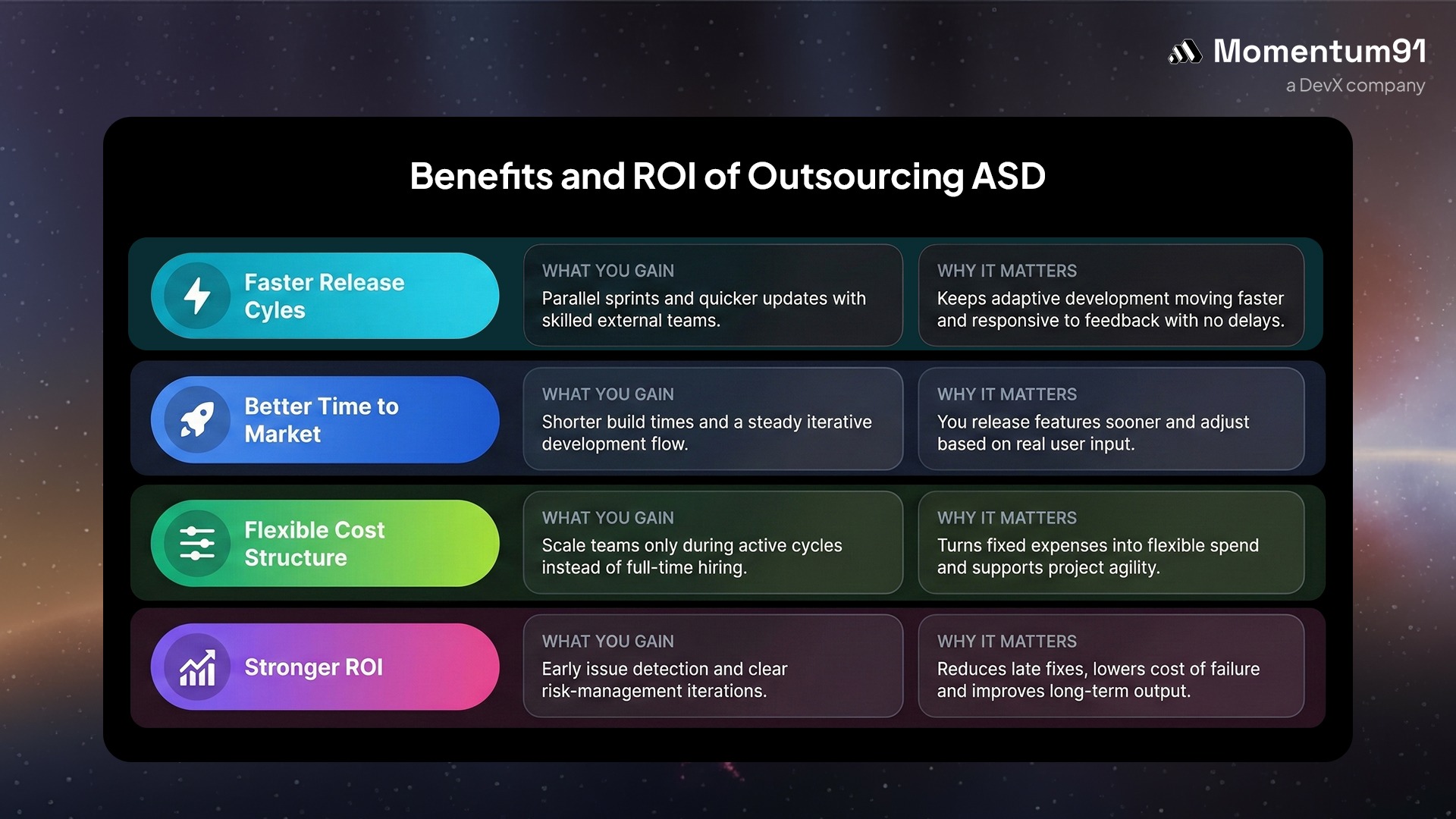
1. Faster Release Cycles
A skilled partner speeds up iterative development by running work in parallel. This shortens build times and brings new features to users sooner. You adapt quickly when customer feedback changes your direction.
2. Better Time to Market
Teams that use outsourcing avoid long waits for internal approvals. Offshore members support constant updates and reduce bottlenecks. This makes the adaptive software development model more effective because feedback loops stay active.
3. Flexible Cost Structure
You avoid the cost of building a full in house setup. Outsourcing adaptive software development lets you scale only during active sprints. This turns fixed expenses into flexible spending and improves the financial side of iterative work.
4. Stronger ROI From Early Issue Detection
Vendors trained in adaptive software development catch issues early through short cycles, shared dashboards and frequent reviews. This lowers the cost of failure and improves long term output. It also pairs well with agile software development practices.
Quick Glance: Benefits and ROI of Outsourcing ASD
A clear outlook helps you decide if your project is a fit for ASD outsourcing. The next section shows when this model works best.
When Does Outsourcing ASD Make Sense?
Outsourcing adaptive software development works well for teams that deal with fast changes, shifting priorities and uncertain requirements. It gives you access to skilled people who understand iterative development and continuous adaptation. But this model is not suited for every project, so it helps to check where your situation fits.
Scenario A: High Uncertainty
If you are building an MVP, testing a new market or adjusting your product weekly, outsourcing adaptive software development supports this pace. You run short cycles, update based on feedback and refine features without slowing down. This setup handles scope changes, early learning and rapid delivery cycles.
Scenario B: Skill Gaps
If you need AI, blockchain or advanced integrations and cannot hire full time, outsourcing fills those gaps quickly. A vendor trained in adaptive software development already works with shared dashboards, quick sprint reviews and clear collaboration patterns that keep things moving.
Scenario C: Fully Fixed Scope
If your project requires strict compliance, locked documentation or zero change tolerance, this model is not a match. In these cases, agile software development or standard delivery with a predictable plan fits better.
Knowing where your project fits helps you avoid slowdowns later. Up next, you’ll see the practical steps that keep ASD outsourcing running smoothly..
The Challenges in ASD and How to Solve Them
Outsourcing adaptive software development gives teams faster output, better project flexibility and steady progress, but it also introduces a few common challenges.
These issues show up when feedback slows down or when teams skip the structure needed for iterative development. With the right habits in place, outsourcing adaptive software development stays predictable and productive.
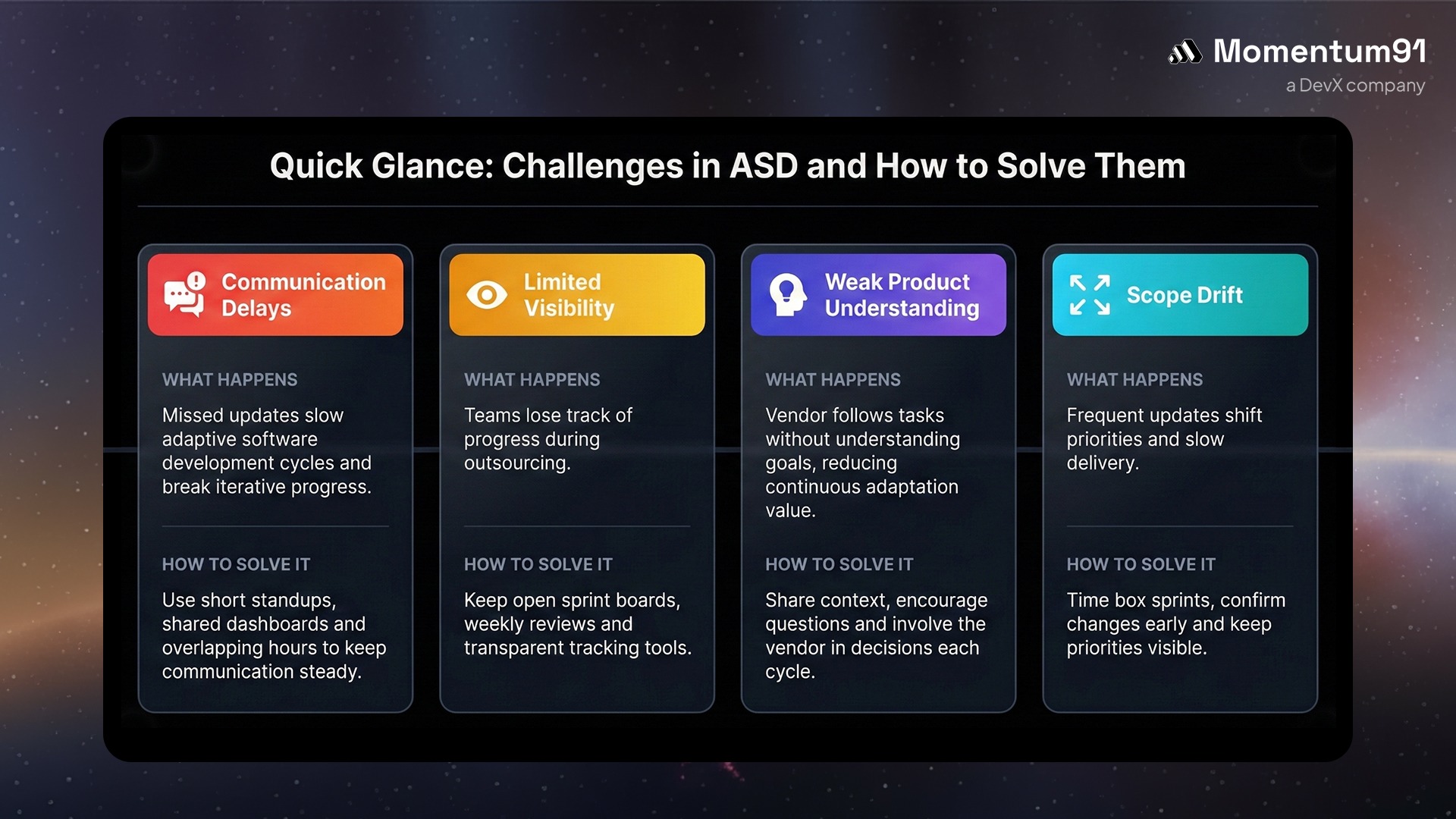
Challenge #1. Communication Delays
ASD relies on quick updates. A missed message can interrupt rapid delivery cycles.
Solution: Set short standups, keep overlapping work hours and use shared dashboards that track every update. This keeps continuous adaptation steady.
Challenge #2. Limited Visibility
Some teams fear losing track of work after outsourcing.
Solution: Use open sprint boards and weekly reviews. Vendors trained in adaptive software development show progress through each step.
Challenge #3. Weak Product Understanding
If the vendor only executes tasks, ASD loses its value.
Solution: Share product goals clearly, invite questions and allow the vendor to take part in decisions during each cycle. This improves risk management iterations.
Challenge #4. Scope Drift
Frequent changes can shift priorities without a clear structure.
Solution: Time box sprints, confirm updates before they move forward and keep priorities visible.
Quick Glance: Challenges in ASD and How to Solve Them
A strong partner makes outsourcing adaptive software development easier to handle.
How Momentum91 Streamlines ASD Outsourcing
Momentum91 brings together strong AI, development and design expertise to help you scale adaptive software development projects with speed and control. With 8 years of delivery experience, a global setup across 25 centers in 11 cities and a talent network of over 13,000 specialists, we provide embedded teams that operate like your own.
We work fast. More than 95 percent of adaptive software development teams go live in under 10 weeks. You get support across PoC development, product builds, UX strategy, iterative development, and steady continuous adaptation through each cycle.
Key Strengths
- AI First Thinking: We integrate AI where it supports stronger outcomes in adaptive software development.
- End to End Development: We manage every phase of adaptive software development, from concept to delivery.
- Full Stack Execution: Engineers, designers and product owners support your long term adaptive software development roadmap.
- Embedded Product Teams: Offshore teams match your rhythm and support real project flexibility.
- Scalable Talent: Momentum91 builds teams fast with one of India’s largest partner networks.
Momentum91 helps you combine adaptive software development with agile software development, giving you steady rapid delivery cycles without adding internal load.
Connect with Momentum91 to start your ASD team quickly and run smoother cycles.
Conclusion
Adaptive software development helps teams respond to change with short cycles, steady feedback and quick improvements. It supports flexible updates, but the process still breaks when teams work without clear structure, consistent communication or the right skill mix. These gaps slow down delivery and make it harder to guide the product in the right direction.
When ASD loses structure, issues grow quietly. Delays stack up, features miss user needs and the project moves away from its original goals. Teams spend more time fixing problems than moving forward, and progress becomes uncertain.
Momentum91 keeps adaptive software development stable through strong practices and clear communication routines. Our teams follow agile software development habits, support fast cycles and maintain alignment so your product moves with clarity instead of friction.
Let Momentum91 support your ASD workflow with a team that fits your pace.
FAQs
1. How does agile outsourcing differ from traditional outsourcing?
Traditional outsourcing follows fixed plans. Agile outsourcing uses short cycles, fast feedback and shared decisions. When you apply this to adaptive software development, you get quicker updates, clearer communication and smoother iterative development because teams respond to change instead of waiting for long revisions.
2. What is the average time to market reduction with ASD?
Teams using adaptive software development often reduce delivery time through short cycles, parallel work and rapid delivery cycles. Outsourcing adds more speed because trained teams already work with agile software development habits, steady standups and clear sprint structures that remove delays and keep updates moving.
3. How do you handle scope creep in ASD outsourcing?
Scope creep becomes easier to manage when teams use time boxed sprints, shared dashboards and clear priorities. In adaptive software development, every update moves through iterative development and continuous adaptation, which keeps changes controlled instead of letting them shift the entire project.
4. Is adaptive software development suitable for small startups?
Yes. Startups benefit from adaptive software development because they need quick adjustments, fast experiments and flexible planning. Outsourcing supports them with ready talent, project flexibility and short cycles that help them react to market changes without building large internal teams.
5. What ROI can companies expect from ASD outsourcing?
ROI improves through faster releases, fewer late fixes and strong risk management iterations. Outsourcing adaptive software development gives teams predictable cycles, steady feedback and lower overhead, while agile software development habits help remove delays and keep work aligned with real user needs.
The inbox update you’ll never want to skip
A quick catch-up with ideas, wins, and tips worth stealing, straight to your inbox every week.
The easiest way to reach us.
Share your details and we’ll get back within 24 hours.
Blogs



A plethora of insights,all in one place
From strategy to execution. All the big ideas, practical guides & fresh perspectives that’ll help you scale with confidence
Ebooks
Comprehensive guides that break down the shifts in business and technology, Helping you lead with clarity.

Office Hours
Your direct line to our experts. Practical advice for scaling, right when you need it.

Reports
Data-backed perspectives on where industries are headed, giving you the foresight to make bolder moves.
Newsletter
A quick catch-up with ideas, wins, and tips worth stealing, straight to your inbox every week.
.avif)
Podcasts
Conversations where you get to know everything from the ones who know it best.
.avif)
Hire Offshore Developers, Right Now!
Access top-tier global talent, enterprise infrastructure, and complete regulatory compliance through our proven model.
Start Now